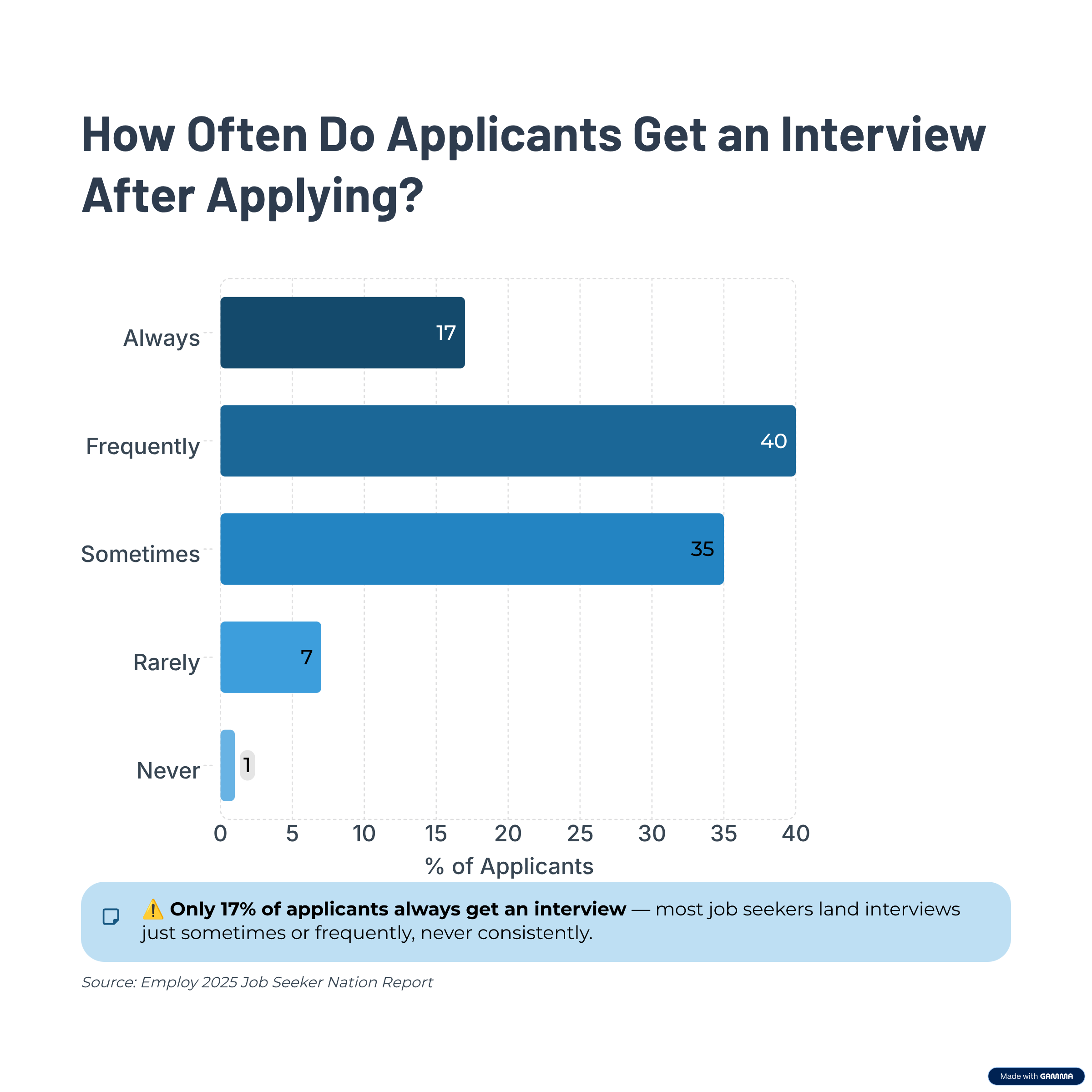
Only 17% of U.S. applicants say they “always” receive an interview after applying.
If that number surprises you, it should. Interviews are hard to get, and going in without preparing is like taking a test you never studied for.
This article is your 7-day interview preparation plan — a step-by-step system that replaces last-minute cramming with a clear, organized approach. It works for any role: software engineering, product, data, finance, marketing, sales, healthcare, operations, consulting, and more.
Yes, this plan takes effort. But it also takes care of you. Job searching is more stressful than most people realize: 72% of job seekers report that job hunting negatively impacts their mental health (according to a Resume Genius survey). Feeling stressed about it doesn’t mean you’re weak. It means you’re human.
Why This Interview Preparation Plan Works When Generic Tips Fail
Most interview advice is either a long list of tips (helpful, but hard to use when you’re short on time) or vague encouragement like “just be confident!” with no real plan behind it.
Popular resources like Indeed’s interview checklist and The Muse’s tips offer good starting points — but they don’t give you a timed, day-by-day system with templates and practice drills. CareerOneStop’s advice is also useful, but it’s not laid out as a week-long action plan.
This matters because hiring now takes longer than ever. According to Gem’s 2025 recruiting data, companies ran 42% more interviews per hire than in 2021 (20 vs. 14), and the average time to hire went up 24% (41 vs. 33 days). In short: companies are comparing more candidates over a longer process. The people who win are the ones who come in with clear, well-practiced answers that fit the role.
This blueprint is built around five principles:
- It starts with real company research, not just surface-level facts. Most people only read the “About Us” page. You’ll go much deeper.
- It builds an answer system, not memorized scripts. Memorized answers break under pressure. A good system adapts.
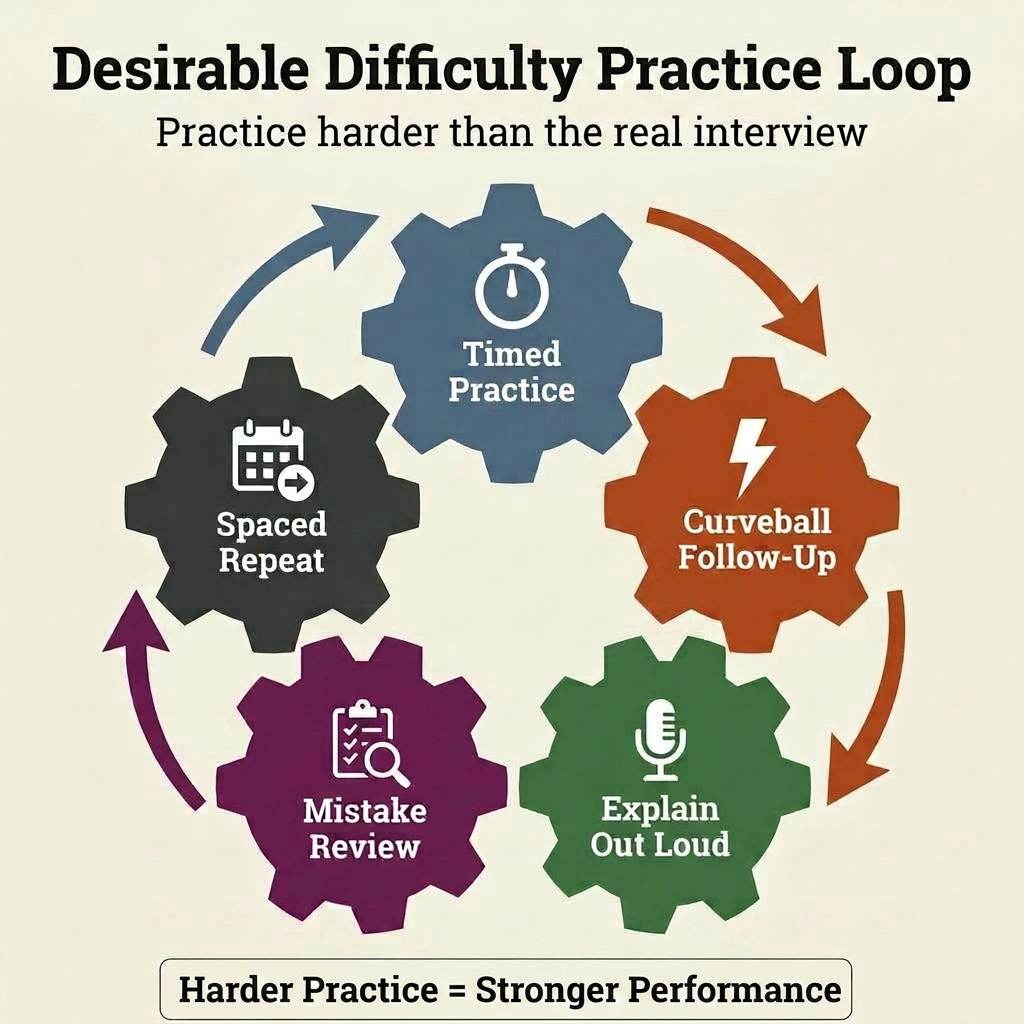
- It uses learning science, not vibes. We’ll apply desirable difficulties — a concept from learning science. The idea is simple: practice that feels harder now actually helps you learn better and remember more.
- It treats mock interviews as the main event. Reading tips is passive. Interviews need you to perform under pressure.
- It protects your energy. Because burnout is real: in Employ’s 2025 Job Seeker Nation Report, 66% of respondents said they feel burned out from searching for a new job.
The goal isn’t to “sound perfect.” It’s to sound ready — clear, relevant, and calm under pressure.
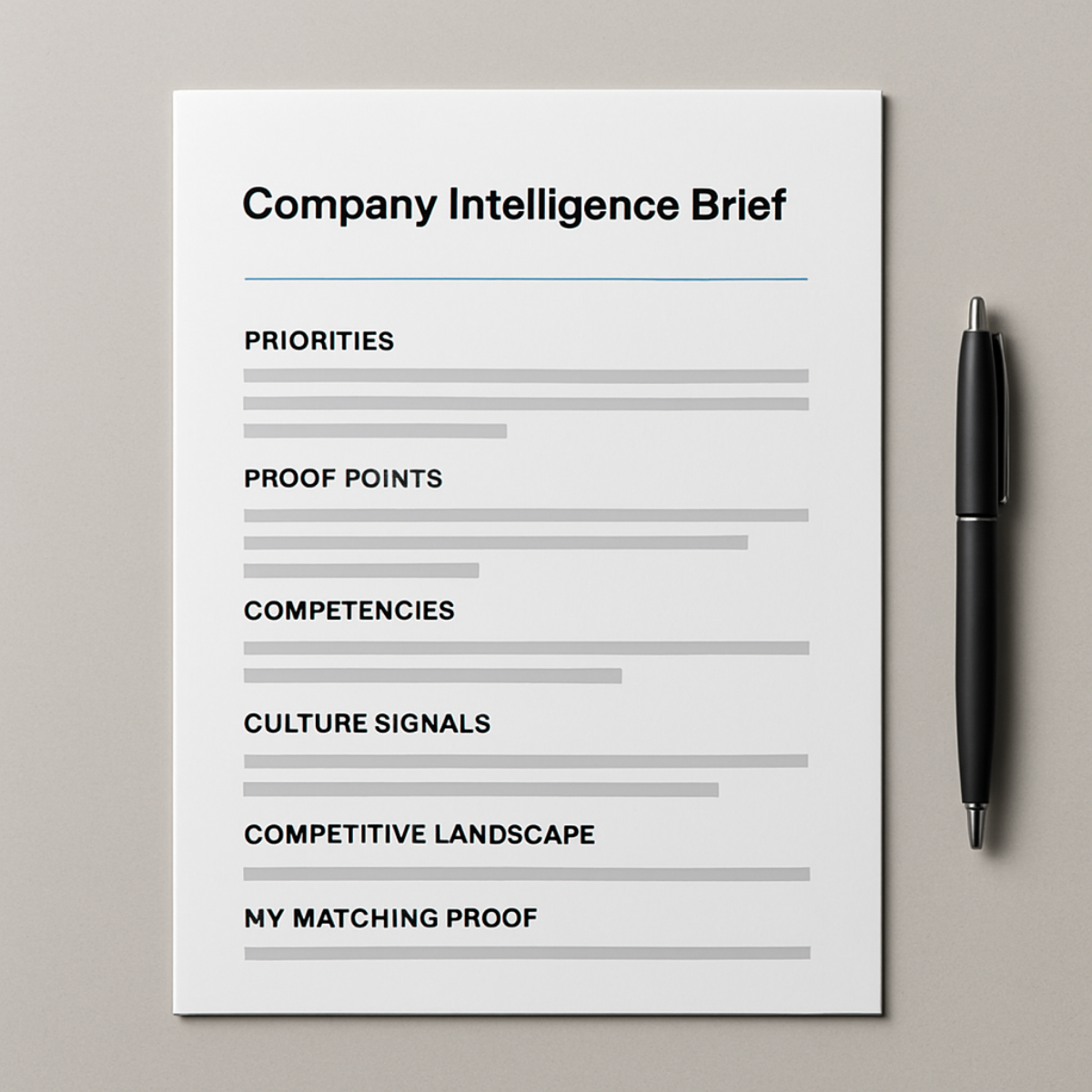
Days 1–2: Deep Research Phase — Build Your Company Intelligence Brief
If you only do one thing in the first two days, do this: build a Company Intelligence Brief — a one-page cheat sheet that helps you give more specific, believable, and convincing answers.
This is where most people fall short. Hiring managers hear “I love your mission” all day long — it doesn’t make you stand out.
Research Beyond the “About Us” Page
You’re trying to answer one simple question: What is this company focused on right now? Not in the past. Not in theory. Right now.
Public Companies: 10-K + Investor Materials
If the company is publicly traded, their annual 10-K report is one of the best resources you can find. It covers the business, its risks, and financial results in detail. You can look up any public company’s 10-K filing for free on the SEC’s EDGAR website.
What to look for:
- Their main products or services and how they make money
- Risks that relate to your role (competition, regulations, AI, privacy)
- Key phrases about their strategy (like “growing internationally,” “keeping customers longer,” or “cutting costs”)
Earnings Call Transcripts: Listen for Goals, Tension, and Priorities
Earnings calls are where company leaders talk about what they need to deliver next — and what investors are pushing them on. Even reading just one call can show you their top priorities, like “keeping more customers,” “launching AI features faster,” or “growing sales to large companies.” You can often find these transcripts on the company’s investor relations page.
What to look for:
- 3 goals the leaders keep repeating
- 2 challenges or risks that analysts bring up
- 1 project or initiative that connects to your role
Press Releases + Product Updates: Spot Momentum
Look for new product launches, partnerships, expansions, or restructuring. Pay attention to any “We are investing in…” statements. Tie these to the job description later.
Glassdoor and Employee-Generated Signals
Don’t take reviews as fact — use them to spot patterns. Look for themes that keep coming up: things like “fast-paced,” “unclear direction,” “great mentorship,” or “too much process.” What people praise most vs. what they complain about will tell you a lot about culture.
LinkedIn: The “In-the-Wild” Culture Feed
Read posts from the hiring manager (if you can find them), people on the same team or in a similar role, and new hires (they often share what onboarding is really like). Notice the company’s tone (formal or casual?), what they celebrate, and how people talk about making a difference.
Decode the Job Description: Find the 3–5 Competencies You’ll Be Tested On
A job description isn’t just a list of tasks — it’s a hidden scorecard wrapped in marketing language. Here’s how to read between the lines:
Highlight and categorize in three passes:
- First pass: Highlight the action words and results — “drive,” “own,” “improve,” “scale,” “lead,” “influence,” “deliver.”
- Second pass: Spot words and themes that repeat. If “stakeholders” shows up 6 times, that’s not an accident — it’s a key skill they’re testing for.
- Third pass: Turn those themes into skills. Most roles really test for just a handful of core competencies.
Typical competency buckets:
- Execution & ownership (shipping, delivering, building)
- Analytical judgment (metrics, decisions, tradeoffs)
- Collaboration & influence (cross-functional work)
- Communication (clarity, storytelling, executive presence)
- Domain / technical depth (tools, frameworks, methods)
Template: The One-Page Company Intelligence Brief
Copy this into a document. Keep it to one page. Review it before every practice session.
Company / Team: _______________ Role: _______________ Interview date(s): _______________
What the company is optimizing for right now:
- Priority 1: _______________
- Priority 2: _______________
- Priority 3: _______________
How they make money / create value (plain English): _______________
Proof points (recent moves):
- Press release / product update #1: _______________
- Press release / product update #2: _______________
- Leadership quote / theme from earnings call: _______________
Competitive landscape:
- Top competitors: _______________
- “Why customers choose them” hypothesis: _______________
- Biggest risk or headwind: _______________
Culture signals (pattern-based):
- What gets rewarded: _______________
- Communication style: _______________
- Decision-making style (fast / consensus / data-heavy): _______________
The scorecard: 3–5 competencies this role screams:
- 1. _______________
- 2. _______________
- 3. _______________
My matching proof (one line each):
- Competency #1 proof: _______________
- Competency #2 proof: _______________
- Competency #3 proof: _______________
If you can’t clearly explain “why this company, why this role, why now” in two short sentences, even your best stories won’t hit home.
Day 3: Story Banking — STAR, Upgraded with Answer Architecture
Today you stop just “thinking of examples” and start building something you can use again and again: a Story Bank.
Why? Because behavioral questions (“Tell me about a time when…”) come up in almost every interview — even technical ones. Many candidates struggle because the questions feel unpredictable. A story bank solves that.
The Classic STAR Method
STAR stands for:
- Situation — what was happening
- Task — what you needed to achieve
- Action — what you did
- Result — what happened
It’s popular because it helps you give structured, specific answers instead of vague ones. You can learn more about it at Big Interview’s STAR method guide. But STAR has one big weakness: most people stop at the “Result” and move on — without connecting the story to the job they’re applying for.
The Answer Architecture Method: STAR, Refined for Real Interviews
Use this for almost any story-based question:
Here’s why it works:
- It opens strong (hook)
- It gives just enough background — not a long story
- It shows how you think (action)
- It puts a number on what you achieved (result)
- It ties it all back to the job (connection)
That last step is what sets you apart.
What the “Connection to Role” Step Does
It answers the question the interviewer is thinking but not asking: “So what?” It shows how your past experience can help them going forward. Instead of hoping the interviewer sees the connection, you spell it out for them — in a natural way.
Example (mini):
Context: “We had cross-team dependencies and unclear ownership.”
Action: “I rebuilt the plan, assigned single-threaded owners, and ran 15-minute daily risk reviews.”
Result: “We shipped on time and reduced post-launch bugs by 30%.”
Connection: “This role is about execution across stakeholders — this is exactly how I run delivery when the stakes are real.”
Build an 8–12 Story Bank That Flexes Across Questions
You want 8–12 stories that you can reuse across different types of questions. Try to cover these types:
- A conflict story (disagreement with a coworker or stakeholder)
- A failure or lesson-learned story
- A story about handling uncertainty
- A story about owning and delivering something big
- A leadership story (you don’t need a leadership title)
- A story about making a data-driven decision
- A story about helping a customer or user
- A “why I’m a great fit” story
Story Bank Template: A Simple Matrix You Can Actually Use
Create a table like this in Google Docs or Notion. Fill in one row per story.
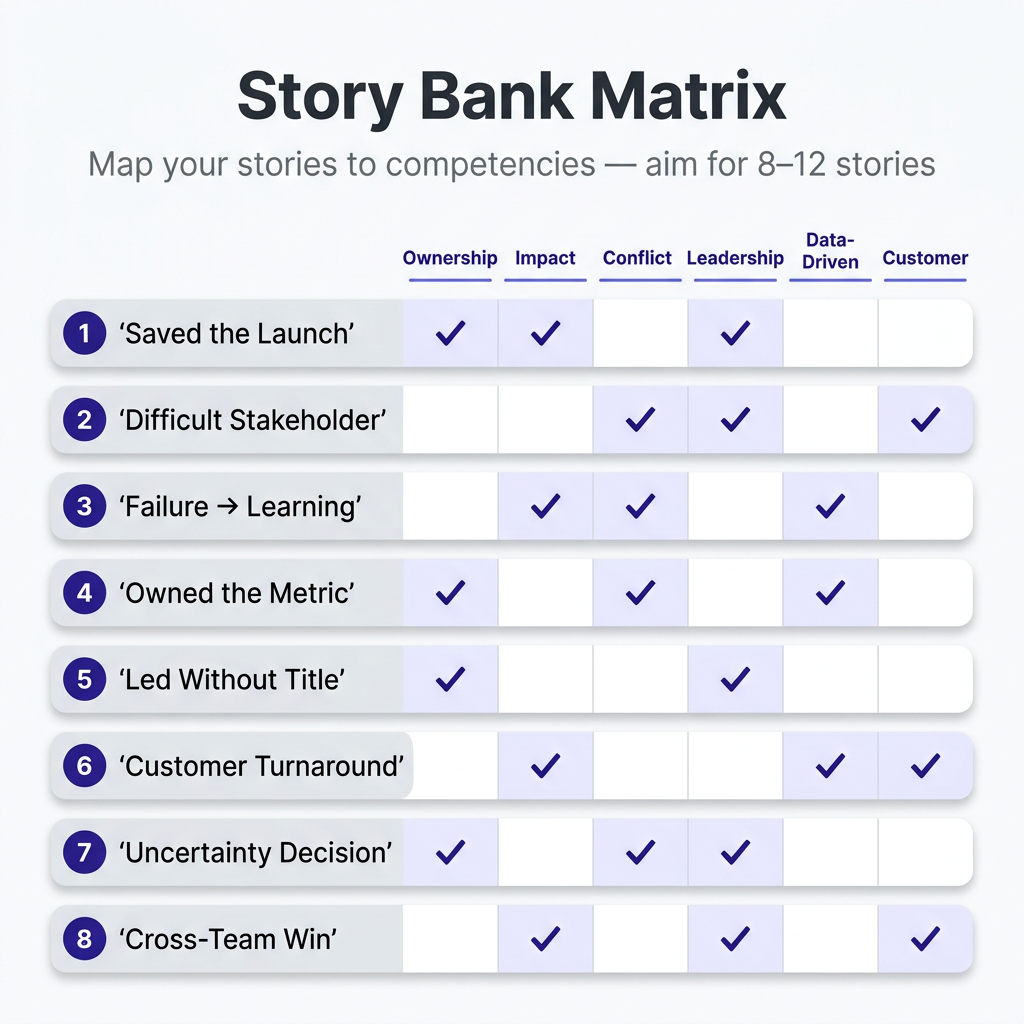
Quick rule: if you can’t tell a story in 90–120 seconds, it needs more editing.
Day 4: Role-Specific Practice — Train Harder Than the Interview
On Day 4, people split into two groups: those who just “review their notes” — and those who train for performance. You’re going to train like it’s the real thing.
What “Desirable Difficulty” Means for Interview Prep
Psychologists Elizabeth and Robert Bjork found that practice which feels harder and slower actually helps you remember things better and apply them in new situations. They also found that feeling good during practice doesn’t always mean you’re actually learning — easy practice might feel smooth, but it often leads to weaker results when it counts.
Interview translation: If practice feels too easy, you’re probably not pushing yourself hard enough.
Day 4 Strategy: Pick Your Core Tasks and Apply Pressure
What you practice depends on your role, but the approach stays the same.
Examples: coding, system design, debugging, take-home cases
- Timed sets: Solve 2 problems in 45 minutes, then explain your answers out loud
- Unfamiliar follow-ups: After you finish, add a twist (“now handle 10x more users”)
- Interleaving: Mix up topics (arrays → graphs → SQL → system design) instead of doing the same type over and over — switching helps you retain more
Examples: marketing, finance, sales, product, healthcare, ops
- Explain to a smart 12-year-old (no jargon): forces you to be truly clear
- Constraint practice: “You have half the budget,” “You can’t hire,” “Legal blocks that feature”
- Numbers-first answers: Every answer includes at least one metric, range, or proxy estimate
Day 4 Micro-Checklist
- Choose 3 role-specific “core tasks” you’ll be evaluated on
- Create 10 prompts (questions, problems, or cases)
- Run 2 timed blocks (45–60 minutes each)
- Record yourself explaining one solution (5–8 minutes)
- Write a “mistake list” you’ll attack on Day 5
Days 5–6: The Mock Interview Engine — Record, Review, Repeat
If you only do one thing to prepare for an interview, make it this: mock interviews.
Reading tips doesn’t build real skill. Actually doing it does. Research shows that retrieval practice — testing yourself — helps you remember things much better than rereading your notes. Studies have shown that people who test themselves recall significantly more than those who just re-study material. A major review of learning techniques also found that practice testing and spaced-out practice are two of the most effective study methods available.
InterviewStudio mock interviews are basically practice tests for your interview. On an AI-powered platform like ours, you can upload your resume and job description and practice with an AI video interviewer that asks follow-up questions and gives feedback afterward — which means you can practice at midnight on a Tuesday and still get useful notes on how you did.
Passive vs. Active Preparation: The Difference That Changes Outcomes
- Reading question lists
- Watching interview videos
- Rewriting your resume again
- Thinking through answers silently
- Answering out loud on a timer
- Facing unpredictable follow-ups
- Watching playback and fixing patterns
- Repeating until it’s automatic
This is also where you start dealing with nerves. Interview anxiety is very real — some people lose sleep, stutter, or feel physically sick from the stress. Practicing mock interviews doesn’t just improve your answers — it helps your body get used to the pressure so you’re less rattled on the day.
How to Structure a Mock Session That Actually Improves You
Do this twice: once on Day 5, once on Day 6. Target 60–75 minutes per session.
Record every session. Audio works, but video is even better. When you play it back, watch for:
- Filler words (“like,” “um,” “you know”)
- Answer length (aim for 60–120 seconds for most answers)
- Your eye contact and posture
- Whether you connected your story back to the role
- Your energy in the first 30 seconds
The First 30 Seconds — Managing Your Opening Impression
Some research suggests interviewers may start forming opinions within 7–30 seconds, and then spend the rest of the interview looking for evidence that confirms their first impression. More detailed research suggests true snap judgments in the first minute are actually rare (around 5% of cases), and most decisions form between 5 and 15 minutes into the interview.
The practical takeaway: even if the final decision takes longer, your first impression shapes how the interviewer sees everything else you say. So practice your opening the way an athlete practices the start of a race.
Drill: Practice the First 30 Seconds of Three High-Leverage Questions
You’re going to script just the first 30 seconds — not the whole answer. Why? Because the opening is where people tend to ramble, over-apologize, or lose confidence.
Tell me about yourself — 30-second opener structure:
Present (who you are professionally, 1 line) → Past (1–2 achievements aligned to role) → Future (why this role makes sense now)
Why this company — 30-second opener structure:
Specific trigger (recent initiative, product, or strategy) → Why it matters (connect to your values or craft) → Role fit (where you contribute)
Why should we hire you — 30-second opener structure:
Three-part proof: competency + evidence + relevance
Where AI Mock Interviews Fit — and Why They’ve Become a Shortcut
Traditional mock interviews can be hard to schedule, uncomfortable, or costly. AI tools make it possible to practice anytime. Use AI tools to get lots of practice reps in. Use real people (when you can) for more detailed qualitative feedback.
Days 6–7: Mental Prep & Logistics — Protect the Instrument
You can know all the right answers and still do poorly if you’re stressed out, tired, or rushing to figure out logistics the morning of.
Let’s be honest: job searching takes a toll. That Resume Genius survey found 72% of job seekers said it negatively affected their mental health — and 66% feel burned out. That’s why Days 6–7 include short recovery breaks built right into the plan, not as an afterthought.
Daily Micro-Recovery Rituals: 5 Minutes That Keep You Steady
Pick two each day. Do them after your prep sessions so your mind learns to shift from work mode to rest mode.
- Box breathing (2 minutes): breathe in for 4 counts, hold for 4, breathe out for 4, hold for 4
- Walk outside (8–12 minutes): leave your phone behind
- One-page brain dump (5 minutes): write down your worries, then write one thing you can do next
- Text a friend one sentence: “Interview week. Can you send me some encouragement?”
- Micro-strength reset (3 minutes): push-ups, squats, or stretches
Visualization, Backed by Sports Psychology
Athletes regularly use visualization — mentally rehearsing a performance before it happens — to improve their results. Researchers created a method called PETTLEP to make mental rehearsal feel as close to the real thing as possible.
For interviews, don’t just “imagine doing well.” Walk through the whole experience in your mind, step by step:
- Physical: Sit the way you’ll sit in the interview
- Environment: Picture the Zoom screen or the room
- Task: Hear the first question in your mind
- Timing: Answer at your normal pace
- Emotion: Feel the nerves, then feel them calm down
- Perspective: See it through your own eyes (not as if you’re watching yourself on a screen)
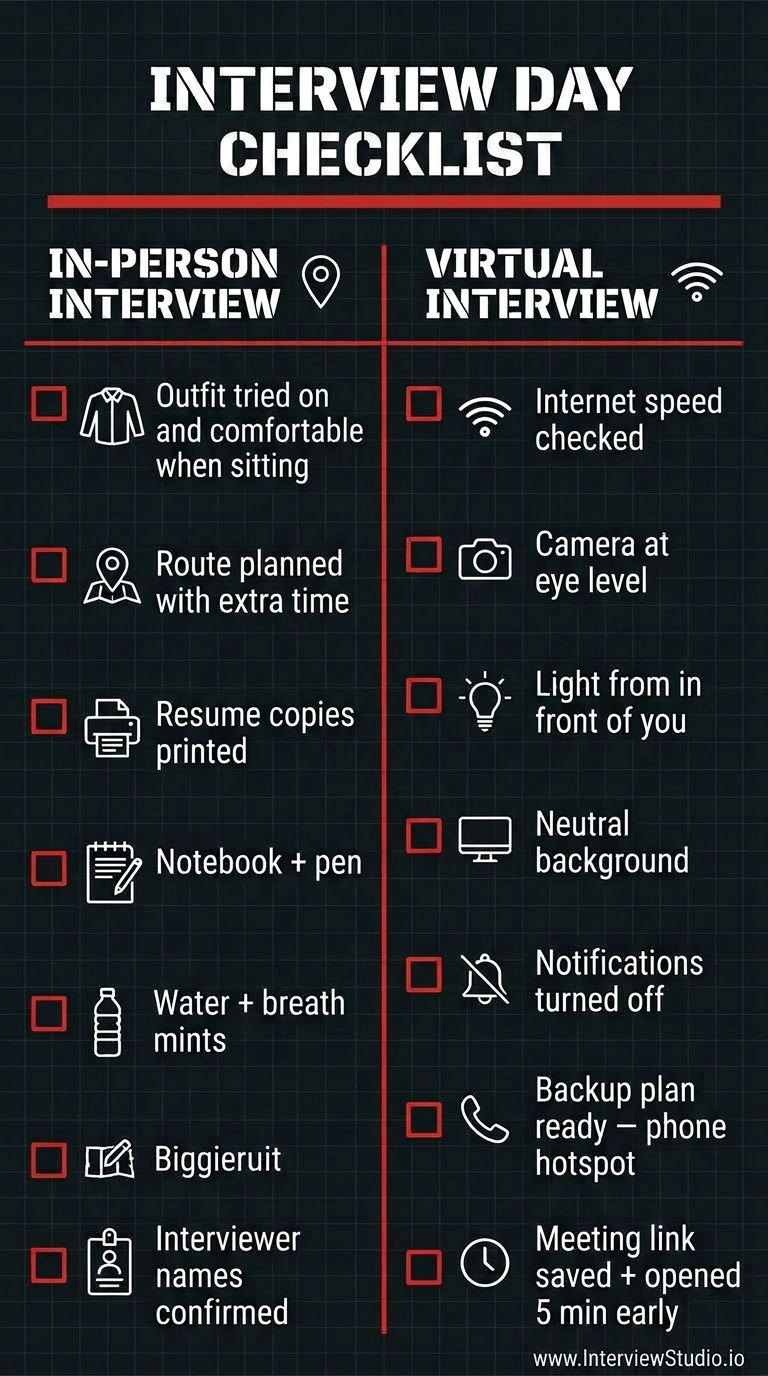
Pre-Interview Logistics Checklist
Every bit of unnecessary hassle drains your energy. Your job is to remove every preventable source of stress.
The Final Two Hours Before the Interview
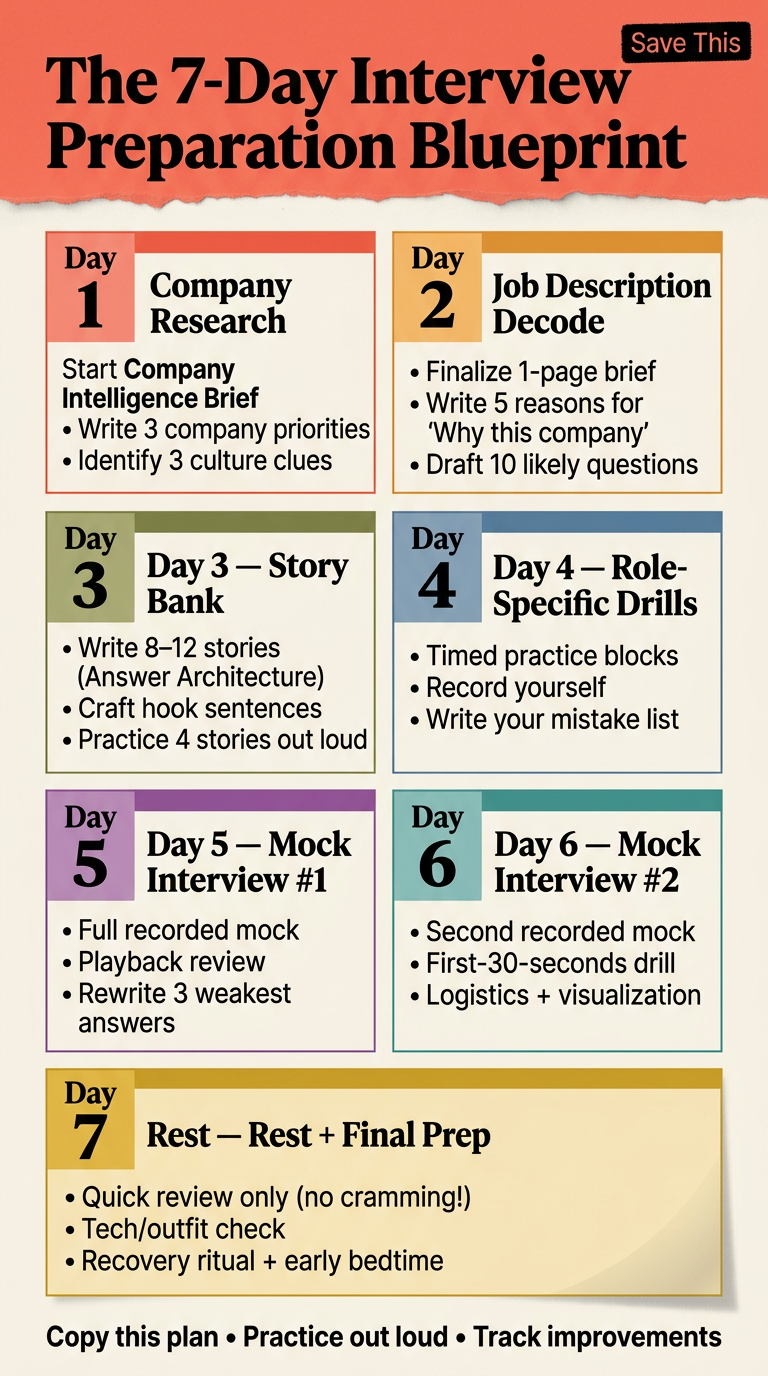
The Full 7-Day Interview Prep Checklist
Use this as your day-by-day plan. Copy it, print it, or save it as a PDF.
Key Takeaways
A great interview doesn’t come from faking confidence — it comes from having a system you can rely on.
- Research like a strategist, not a fan. Build a one-page Company Intelligence Brief that captures priorities, culture signals, and the 3–5 competencies the role screams.
- Answer with structure: STAR is good; Answer Architecture is better. The last step — connecting your story to the role — is what separates a good answer from a memorable one.
- Train under pressure. Harder practice (timed, with curveballs, interleaved topics) builds the kind of confidence that holds up in a real interview.
- Mock interviews are the multiplier. Doing beats reading — every time. Record yourself and fix the patterns you see.
- Protect your mental state and logistics. Job searching is tough, so plan for rest, not just work. Remove every source of preventable stress before the day.
If you follow this plan for seven days, you won’t just “hope to do well.” You’ll walk in knowing exactly what to do — because you’ve already done it.
Ready to Turn This Plan Into Real Confidence?
Start a free AI mock interview and practice with a real-time video interviewer that adapts to your resume and target role — so your next interview feels familiar before you ever walk in the door.
Start Your Free Mock Interview →