
Laszlo Bock, the man who ran hiring for Google during its brainteaser-obsessed years, eventually admitted something uncomfortable: after analyzing tens of thousands of interviews, his team found “zero relationship” between how well someone answered a mind-bending puzzle and how well they actually performed on the job. Google banned brainteasers shortly after. And yet, in 2025, roughly one in four candidates still walks into an interview and gets blindsided by a question they never saw coming.
If you’re a mid-career or senior professional, this should feel personal. You’ve done the prep. You’ve rehearsed your “tell me about yourself.” You know your resume cold. Then someone asks, “How many tennis balls would fit in this room?” or “If you were a kitchen appliance, which one would you be?” — and every ounce of that preparation evaporates.
This guide is about what to do in that exact moment. We’ll cover why curveball interview questions exist, a simple rule for buying yourself time without looking rattled, three frameworks you can apply to almost any tricky interview question, and the psychological science that explains why some pressure actually helps you — as long as you’ve trained for it.
Why Interviewers Ask Curveball Questions in the First Place
Here’s the myth to unlearn immediately: there is no hidden “correct” answer to most weird interview questions. Interviewers aren’t grading your math skills or your creative writing. They’re running a live simulation.
Heather Kernahan, general manager and EVP at communications firm Eastwick, described it to Fast Company as “a mini simulation of how they’ll really respond during an unexpected work situation.” Every job has moments where you’re blindsided — a client asks something you didn’t prep for, a deal changes terms mid-negotiation, or a project scope shifts overnight. Unexpected interview questions are a stress test for exactly that.
What Curveballs Are Actually Measuring
When a hiring manager throws you an oddball question, they’re typically watching for:
- Composure under pressure — do you stay grounded or visibly rattle?
- Reasoning process — can they follow how you think, step by step?
- Self-awareness — do you know what you don’t know, and say so honestly?
- Adaptability — can you pivot when the ground shifts under you?
- Authenticity — does your rehearsed interview mask slip, revealing who you really are?
That last point matters more than most candidates realize. By the time you reach a curveball question, you’ve likely already delivered polished answers to the predictable stuff. The unexpected question is often placed deliberately to see what’s underneath the polish.
The Brainteaser Myth, Debunked
For years, “How many golf balls fit in this room?”-style questions were treated as genius filters. Google popularized them — then killed them. Bock told the New York Times in 2013: “On the hiring side, we found that brainteasers are a complete waste of time... They don’t predict anything. They serve primarily to make the interviewer feel smart.”
The broader research backs this up. Schmidt and Hunter’s landmark meta-analysis in Psychological Bulletin found that structured interview formats predict job performance more reliably than unstructured, improvised questioning — the kind of format that produces brainteasers in the first place.
Brainteasers don’t measure how smart you are. They measure how well you handle not knowing the answer — and that’s a skill you can absolutely build.
So if the question isn’t really about the answer, what should you actually be doing when one lands on you?
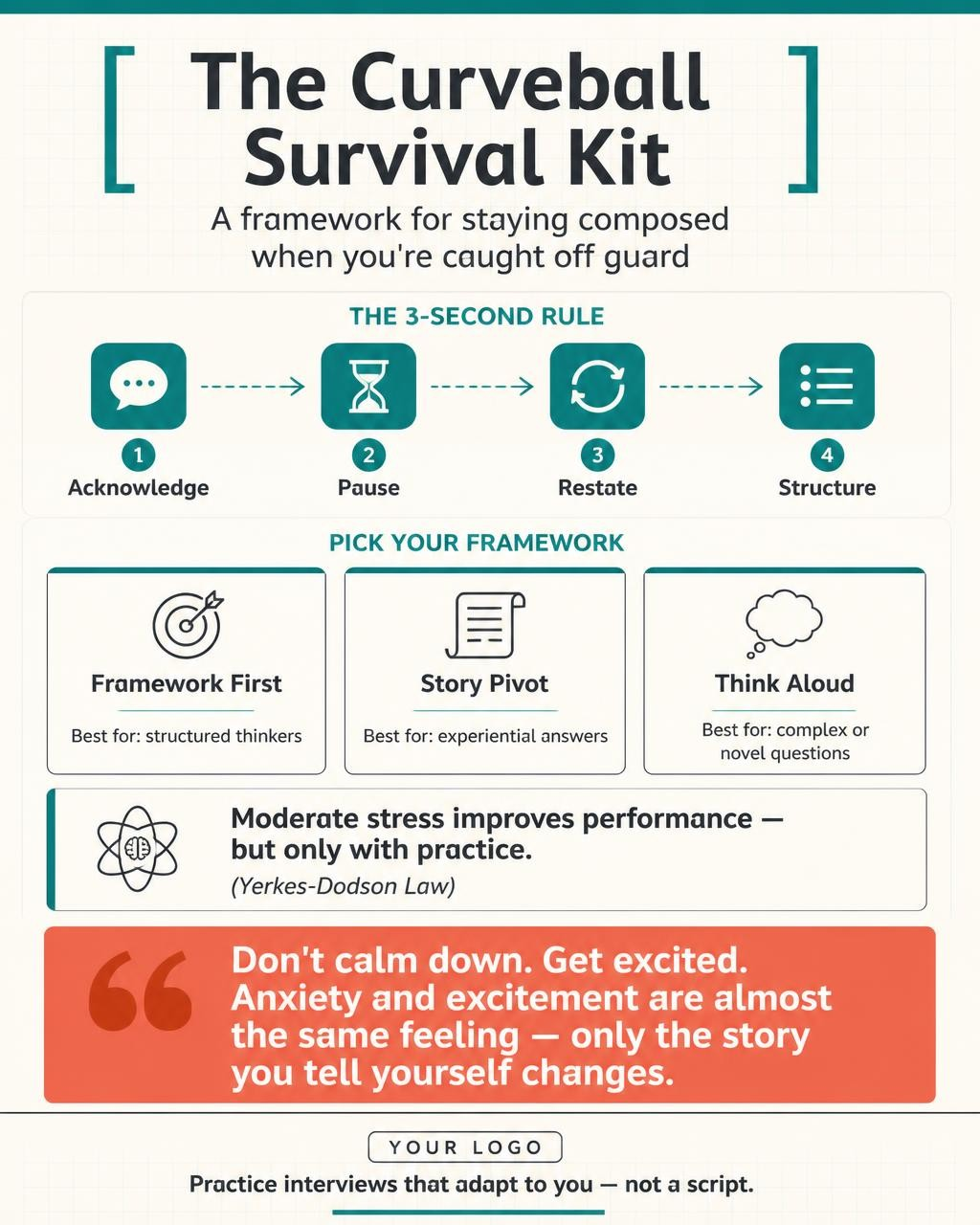
The 3-Second Rule: Your First Move When You’re Caught Off Guard
Most advice about handling tricky interview questions stops at “stay calm” — which is about as useful as telling someone not to think about a pink elephant. Here’s something more specific and more grounded in research.
There’s an interesting tension in the science of pausing. A 2021 study published in the Journal of Personality and Social Psychology, spanning 14 experiments and more than 7,500 participants, found that delayed responses can be perceived as less sincere — even a short gap on a question expecting an instant answer.
But that finding applies to silent, unexplained gaps. For a genuinely hard question, the fix isn’t to avoid pausing. It’s to narrate the pause instead of hiding it.
The 3-Second Rule, Step by Step
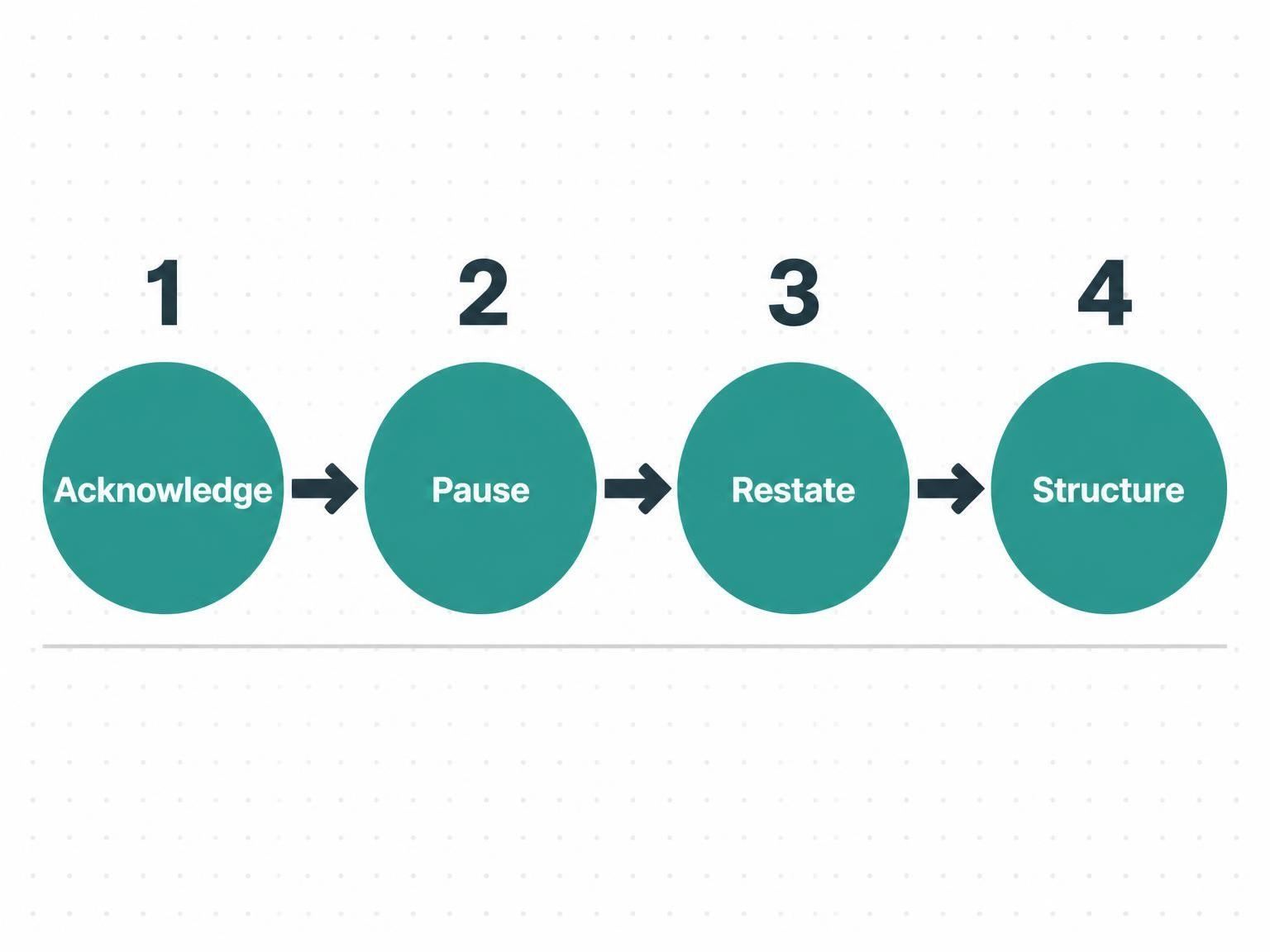
- Acknowledge the question out loud. Say something like: “That’s a great question — let me think about that for a second.” This single sentence does two things: it buys you time, and it signals confidence rather than panic.
- Take a deliberate, visible pause. One to three seconds. Not silence that makes the interviewer wonder if you’ve frozen — a beat that clearly reads as “I’m thinking,” not “I’m stuck.”
- Repeat or rephrase the question. This clarifies what’s actually being asked, buys additional processing time, and shows active listening.
- Structure your response before you start talking in full sentences. Even a simple “I’ll break this into two parts” gives your brain scaffolding to build on as you speak.
Scott Dobroski, who has spent years studying oddball interview questions at Glassdoor, offered this advice for the times you genuinely don’t know where to start: “It’s OK to answer a question with a question, or ask for a clarification.” The worst thing you can do, he noted, is freeze and say nothing at all.
A pause you narrate reads as poise. A pause you hide reads as panic. The difference isn’t the silence — it’s what you say around it.
Once you’ve bought yourself those few seconds, you need somewhere to put your thinking. That’s where frameworks come in.
Three Frameworks for Answering Almost Any Tricky Interview Question
Different curveballs call for different tools. Here are three you can memorize and deploy on the spot — reusable scaffolding for when your prepared answers won’t cut it.
Framework 1: “Framework First” (For Estimation and Analytical Questions)
This is the go-to approach for questions like “How many tennis balls fit in this room?” or “How would you price this product?” — anything that asks you to reason through an unfamiliar problem with incomplete information.
- Clarify and restate the question so you’re solving the right problem.
- Break the problem into clean, non-overlapping components (in consulting, this is called being “MECE” — mutually exclusive, collectively exhaustive). For the tennis ball question, that might mean calculating the room’s volume, then estimating how tennis balls pack within that space.
- State your assumptions out loud using round, defensible numbers.
- Calculate step by step, narrating as you go.
- Deliver your headline first, then the reasoning behind it. “My estimate is roughly X, based on Y and Z” lands better than a long walk-up to a number.
“Let me estimate the room’s dimensions first — I’d guess roughly 20 feet by 15 feet with a 10-foot ceiling, so about 3,000 cubic feet. A tennis ball is roughly 2.5 inches in diameter, and if we account for packing inefficiency and the furniture, I’d estimate somewhere around 50,000 balls could fit.”
Nobody is checking that math against a calculator. They’re checking whether you can build a defensible structure out of nothing.
Framework 2: “Story Pivot” (For Hypothetical and Behavioral Curveballs)
Some curveballs are disguised behavioral questions. “Tell me about a time you failed” is predictable. “If your team hated your leadership style, what would you do?” is the same question wearing a costume.
The move is a pivot: connect the hypothetical to a real, relevant experience using the classic STAR structure:
- Situation: Briefly set the scene of a comparable moment.
- Task: Explain what was actually at stake or expected of you.
- Action: Say what you specifically did — not what “the team” did.
- Result: Share the outcome, ideally with a measurable detail.
“This actually happened to me at [Company]. A client threatened to walk over a missed deadline. I called them within the hour, owned the miss directly, and proposed a revised delivery plan with weekly check-ins. They stayed, and we renewed their contract a year later at a higher tier.”
This works because you’re retrieving a real memory, which is dramatically easier under pressure than generating fiction on the spot.
Framework 3: “Think Aloud” (For Philosophical, Values, and Creative Questions)
Some curveballs have no clean structure and no relevant past story — “What’s a book that changed how you think?” or “If you could have dinner with anyone, who would it be?” These are personality and values probes. The framework is deliberately simple: narrate your reasoning as you form it.
- Start talking about your thought process before landing on a final answer.
- Let the interviewer hear you evaluate options, not just announce a conclusion.
- Land on an answer that reveals something genuine about how you work or what you value.
“My first instinct is something like an octopus — not for the obvious multitasking joke, but because octopi solve problems by directly manipulating their environment rather than waiting for conditions to change. That’s how I approach ambiguous projects: I’d rather test something small immediately than plan extensively before acting.”
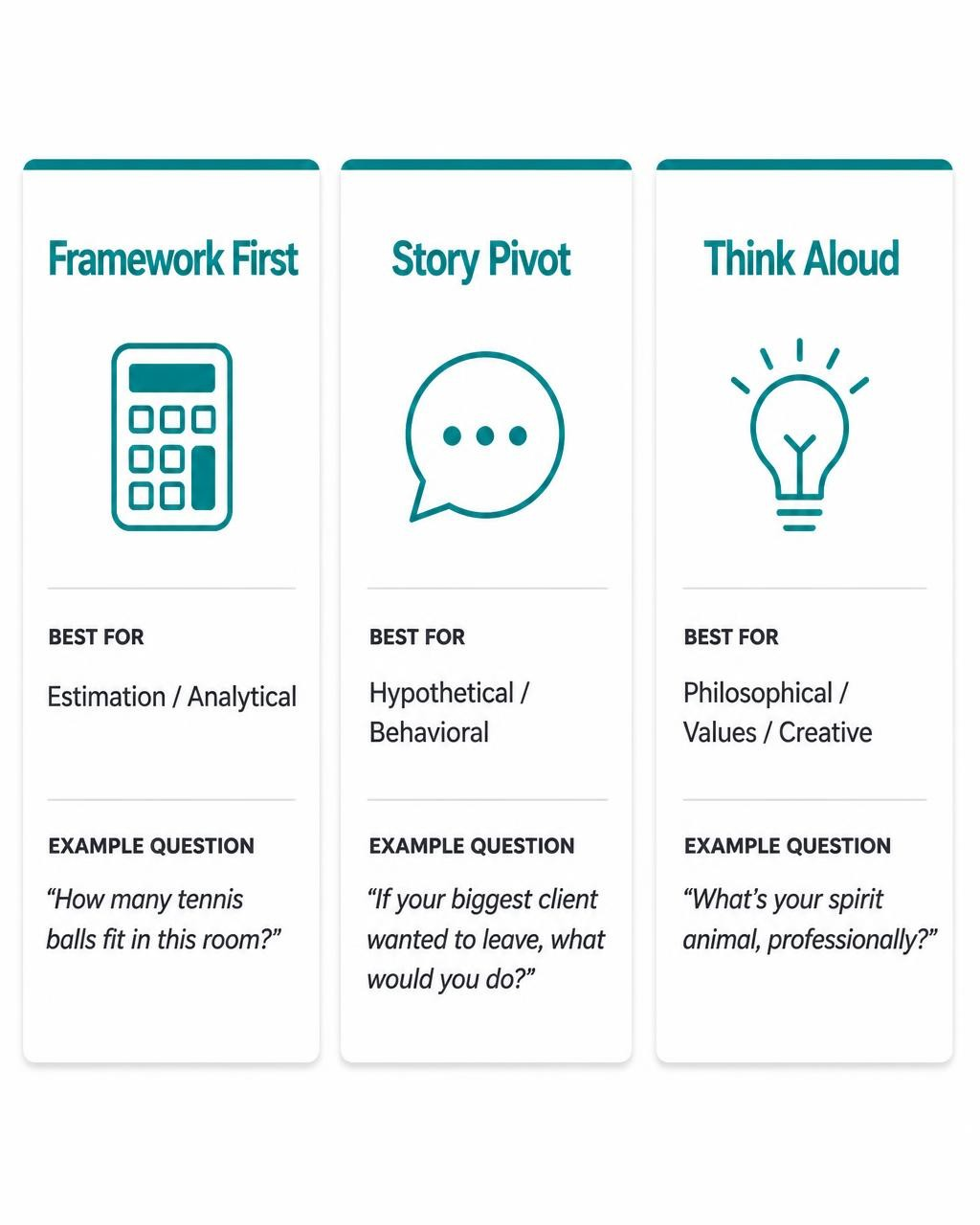
Quick reference — which framework fits which question type:
- Estimation/analytical (“How many X fit in Y?”, “Price this product”) → Framework First
- Hypothetical/behavioral (“What would you do if...”, “How would you handle...”) → Story Pivot
- Philosophical/values/creative (“What’s your spirit animal?”, “What book changed you?”) → Think Aloud
Why Moderate Pressure Actually Makes You Sharper (If You’ve Trained for It)
Here’s the counterintuitive part most career advice skips: you don’t want zero stress in an interview. You want the right amount.
This is described by the Yerkes-Dodson law, a century-old psychology principle that maps stress against performance as an inverted U-shape. Too little pressure and you’re flat, underprepared, and unmemorable. Too much and your working memory gets hijacked — which is the actual mechanism behind “blanking out” on a question you knew the answer to five minutes earlier. Moderate pressure, though, sits at the peak of that curve: alert, focused, sharp.
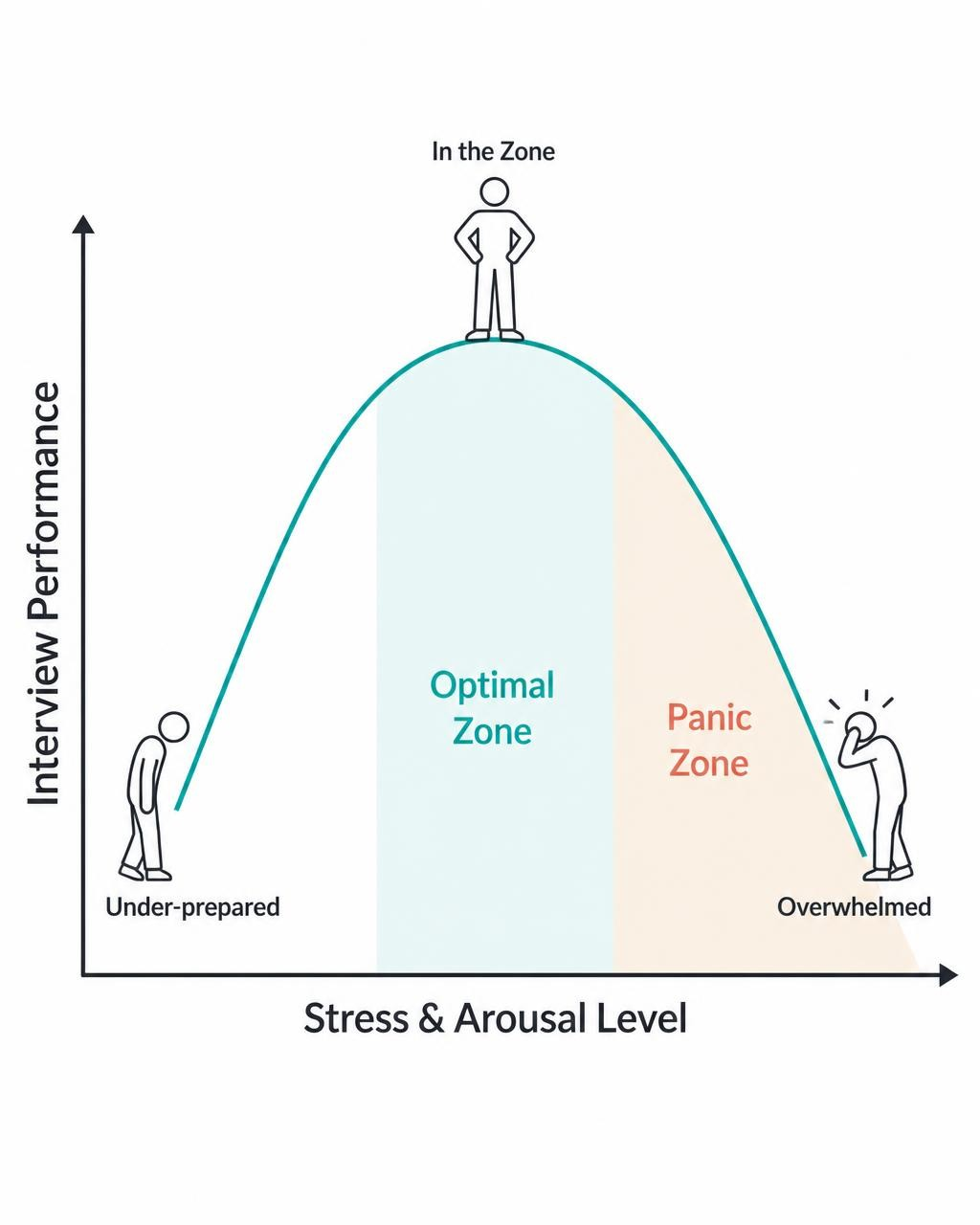
The catch is that this only works in your favor if you’ve practiced recovering from being caught off guard. Someone who has never faced an unpredictable question before will spike straight past that peak into panic. Someone who has rehearsed staying composed under uncertainty stays closer to the top of the curve.
There’s also a simpler psychological trick worth knowing. Harvard Business School researcher Alison Wood Brooks found that people who reframed pre-performance anxiety by telling themselves “I am excited” — rather than trying to calm down — consistently performed better across public speaking, singing, and analytical tasks. Her reasoning: anxiety and excitement are almost physiologically identical; both are high-arousal states. Trying to calm down requires fighting your body’s arousal and changing your mental story. Reframing as excitement only requires changing the story.
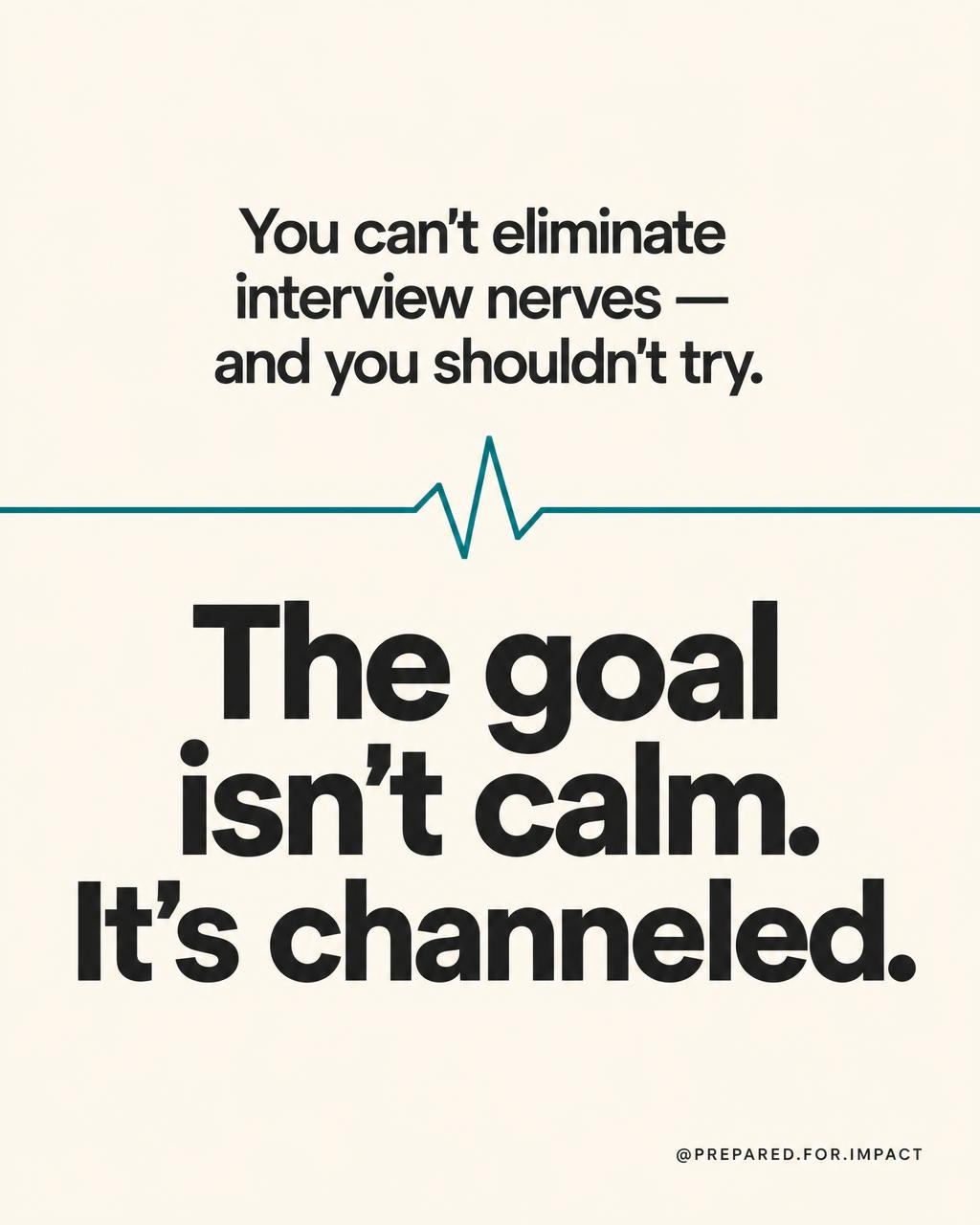
You can’t eliminate interview nerves — and you shouldn’t try. The goal isn’t calm. It’s channeled.
Before your next interview, when that pre-interview jitteriness kicks in, try saying — out loud if you can — “I’m excited for this,” instead of “I need to calm down.” It sounds small. The research says it isn’t. For more ways to work with nerves, read The Science of Interview Anxiety.
The One Thing You Can’t Fully Prepare for in a Mirror
There’s a hard truth buried in all of this: you can memorize every framework in this article and still freeze the first time a real curveball hits you live, because reading about composure and practicing composure are not the same skill.
Rehearsing answers to predictable questions in front of a mirror doesn’t train the specific muscle a curveball requires — the ability to think on your feet while someone is watching and waiting. That only gets built through repetition under realistic, unpredictable conditions.
This is precisely why practicing with dynamic, adaptive mock interviews matters more than memorizing a script. An AI interviewer that listens to your actual answers and asks genuine follow-up questions — rather than working through a fixed list — puts you in a position much closer to the real thing: you genuinely don’t know what’s coming next, so you have to build the skill of staying composed in real time, not just the skill of reciting prepared material.
That’s a fundamentally different kind of practice than reading a list of “50 tricky interview questions and answers” the night before — because memorized answers only help until the real question deviates even slightly from the script. And it almost always does. Build your fundamentals with our guide to 50 behavioral interview questions, then learn how adaptive mock interviews and feedback work.

Key Takeaways
Handling curveball interview questions without panicking comes down to a small number of repeatable moves:
- Curveballs test composure and reasoning, not correctness — there’s rarely a single “right” answer, so stop searching for one.
- Use the 3-second rule: acknowledge the question, pause deliberately, restate it, then structure your answer before diving in.
- Match the framework to the question type — Framework First for estimation questions, Story Pivot for hypotheticals, Think Aloud for values and creative prompts.
- Moderate stress sharpens performance — but only if you’ve built the muscle of recovering from the unexpected through real practice.
- Reframe nerves as excitement, not something to suppress — it’s a small mental shift with outsized results.
The next time an interviewer throws you a question you didn’t see coming, you won’t need to hope you get lucky. You’ll have a process. And the best way to make that process feel automatic under real pressure — rather than something you’re trying to remember in the moment — is to practice it against questions you genuinely can’t predict, the same way you’ll face them in the room that actually matters.
Make Curveball Questions Feel Familiar
Practice with an AI interviewer that asks real, adaptive follow-up questions — not a fixed script — so you build genuine composure, not memorized answers.
Start Practicing Free
