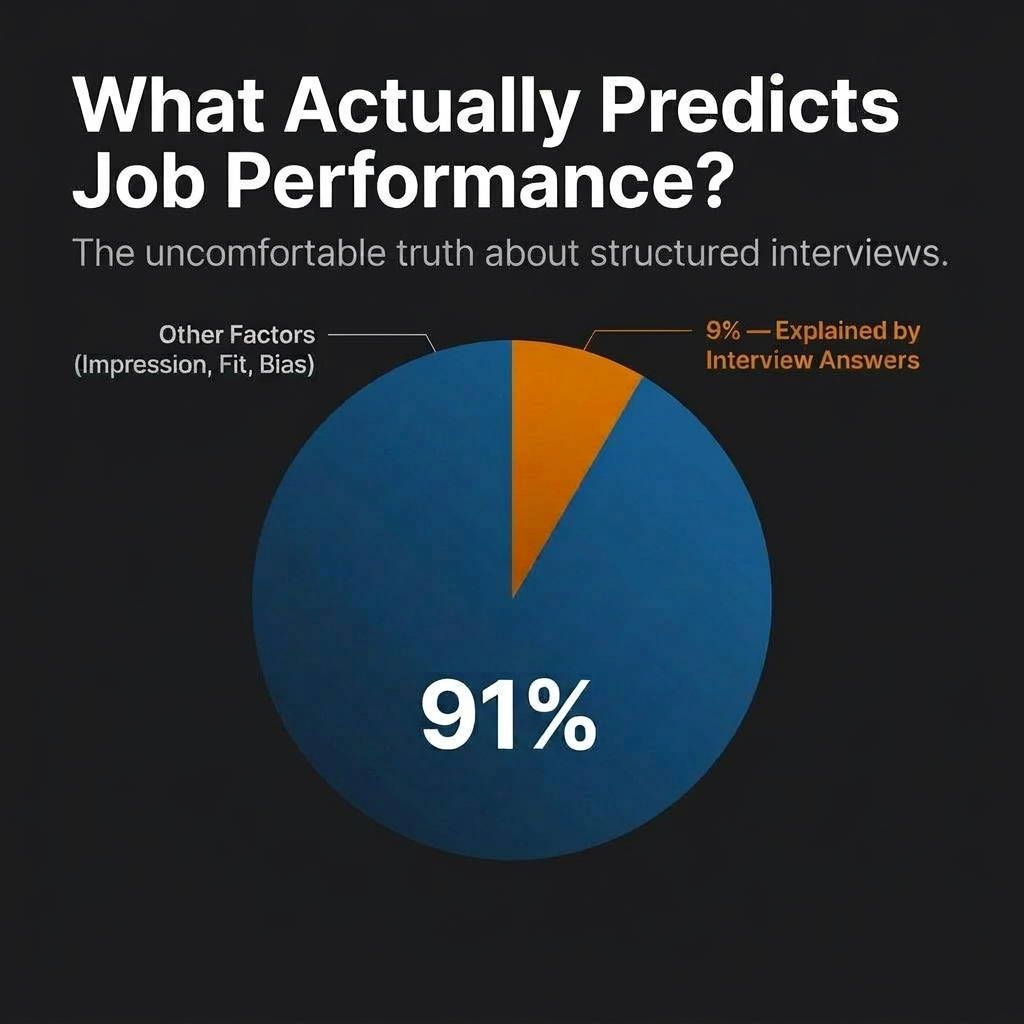
You’d think great answers are what win interviews — but science disagrees. A recent study found that traditional interviews only account for about 9% of how well someone actually does on the job. That means 91% of what decides your success has nothing to do with your answers. If you’ve ever wondered “I know I can do this job, so why do I keep getting rejected?”, you’re not alone. The reality is that interviews are far more about how you come across — your energy, your body language, and the quick judgments people make — than the actual words you say.
Most people prepare for the wrong things. They memorize answers, walk in, and don’t realize the interviewer already made up their mind in the first few seconds. Preparation matters — but the wrong kind of preparation leads to disappointment. Most interview advice focuses on what to say. But decades of research show that how well you interview is only loosely connected to how well you’ll actually do the job. What really matters is making the interviewer feel confident in you — through your energy, your connection with them, and your body language — almost from the moment you walk in.
“91% of interview success has nothing to do with your answers.”
Most of us think “I just need to give good answers.” But in reality, how you come across matters more. This doesn’t mean you should stop preparing your answers — but it does mean you might be missing the things that matter most: first impressions, body language, and the hidden biases that shape every interview.
The 91% Revelation: Why Interview Answers Matter Less Than You Think
It sounds hard to believe: interviews only predict about 9% of how well someone will actually perform at work. This comes from researchers who have studied hiring for decades. A 2024 analysis by Wingate and colleagues confirmed it — interviews leave 91% of job performance unexplained. So even giving a perfect answer doesn’t guarantee you’ll be seen as the best person for the job.
What does this actually mean? Simply put, the person who gave the most impressive answers isn’t always the best hire. The other 91% comes from things that are harder to pin down — like luck (maybe the interviewer was in a good mood), and how you made the interviewer feel.
This might sound discouraging, but it’s actually good news once you know what’s really going on. It just means the game isn’t what you thought. Instead of obsessing over technical details, the smart candidate spends half their prep time on how they deliver their answers: how they walk in, their body language, their tone of voice, and how they connect with the interviewer.
“The best interview performers aren’t always the best candidates — they’re the ones who made the interviewer feel confident and excited.”
The Thin-Slicing Phenomenon: First Impressions Decide Quickly
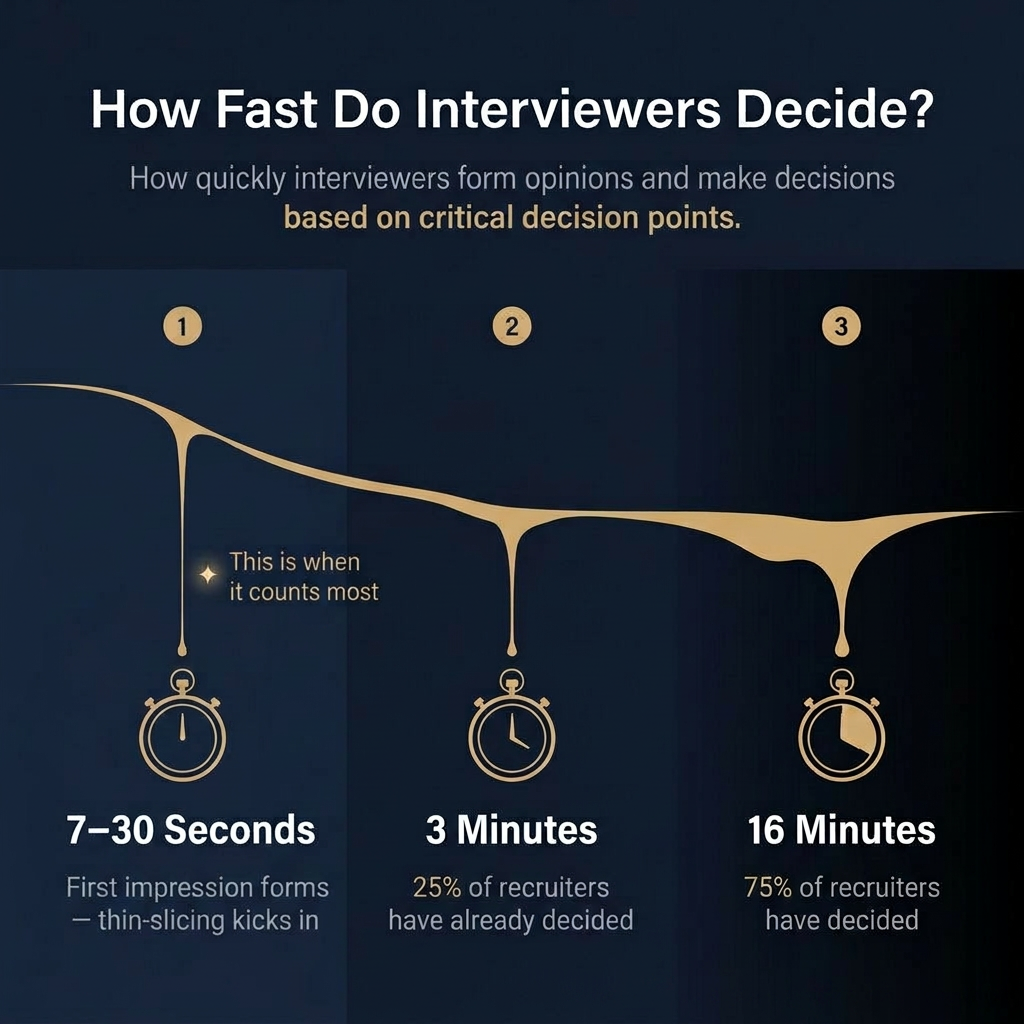
Our brains are built to make quick decisions. Think of the book Blink or basic psychology: interviewers are doing something called “thin-slicing.” Malcolm Gladwell showed how snap decisions (sometimes in under a second) shape how we see people. Research backs this up. Ambady and Rosenthal’s well-known thin-slice studies showed that people could accurately judge someone’s personality or skills from just 30-second clips. What’s surprising is that watching for longer didn’t make the judgments much better — our brains grab just enough information in a moment to form a lasting impression.
For interviews, this means your first few seconds matter a lot. One study (NYU, 2015) found that 75% of recruiters make up their mind within 16 minutes, and 25% decide within just 3 minutes. Some even say it happens in the first 30 seconds. By the time you answer your second question, the interviewer may have already decided. The rest of the interview is often just confirming what they already feel.
So what happens in those key moments? The interviewer notices:
- Your entry and greeting — do you walk in confidently? Smile? Make eye contact?
- Your energy level and enthusiasm
- Your tone of voice and posture
Without realizing it, the interviewer is asking themselves, “Could I work with this person every day?” before they even hear about your skills. The question “Can they do the job?” comes later — and it’s shaped by that first impression. That’s why you need an entrance strategy. Plan how you’ll start: a confident intro, a genuine smile, an engaging posture. These first 90 seconds are your golden window.
Why First Impressions Stick
Once the interviewer labels you in their mind (“friendly,” “nervous,” “confident,” “boring”), confirmation bias takes over: they start looking for proof that their first impression was right. If they saw you as confident, every good answer confirms it. If they saw you as nervous, every “um” confirms that instead. This is the thin-slicing loop of interviews.
Don’t waste the start. Walk in like you belong there. Use an “opening sentence” that’s warm and strong. Sit with open posture, make eye contact, and match the interviewer’s energy. If they’re calm and formal, match that. If they’re upbeat, bring your energy up a bit. You’re giving a mini pitch in those first moments — you want them to like you right away.
Five Cognitive Biases That Shape Every Interview
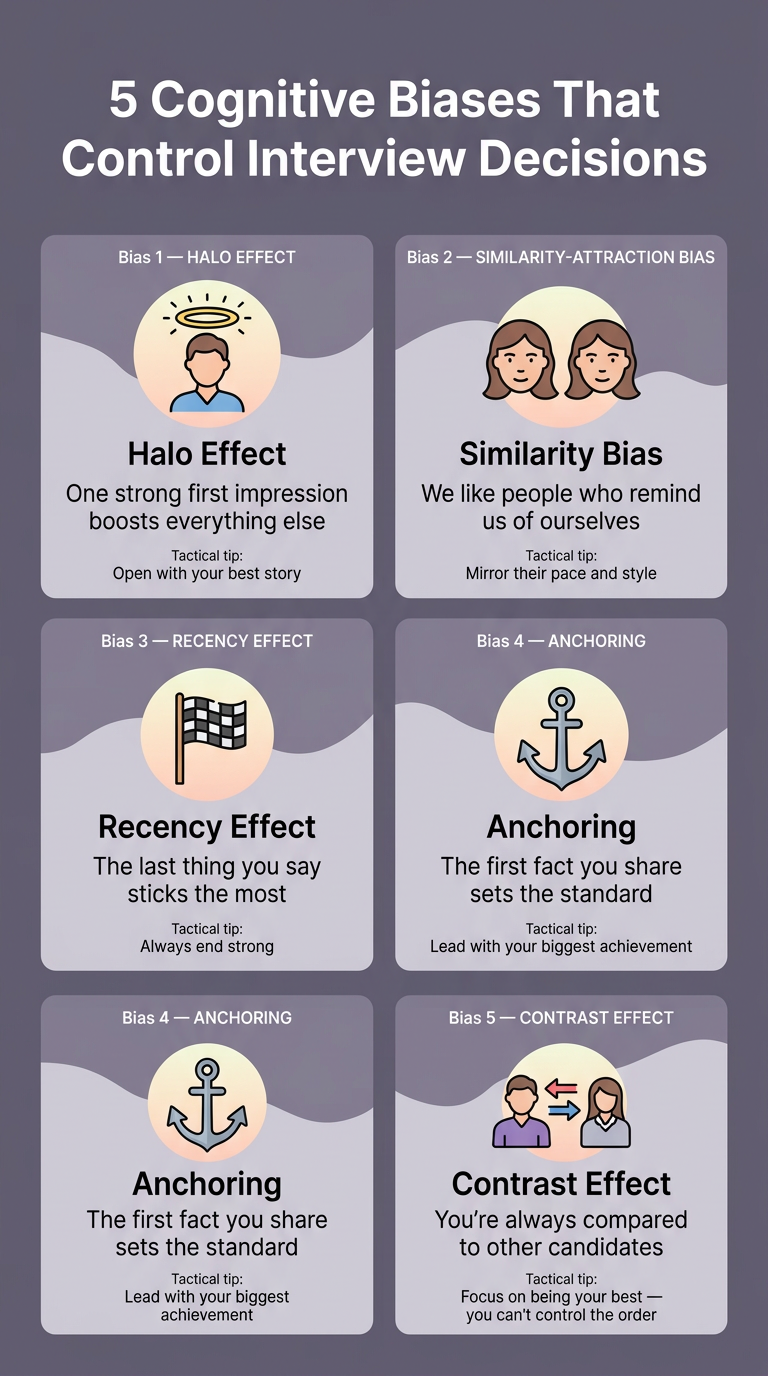
Interview decisions aren’t based on pure logic — they’re shaped by mental shortcuts called cognitive biases. Once you understand them, you can use them to your advantage. Here are five biases that come up in every interview, and how to work with them.
-
Halo Effect
When one positive thing about you makes everything else look good. For example, if you open with a confident smile and articulate intro, the interviewer will unconsciously rate you higher on everything else too. But one awkward moment at the start can drag everything down.
Tactical Tip Put extra effort into your first question and your opener. Treat the first question as your golden moment — have a short, strong story ready that shows both skill and warmth. Even if later answers aren’t perfect, that strong start has already lifted how they see you. -
Similarity-Attraction Bias
People naturally like others who remind them of themselves. If the interviewer shares your background, school, hobby, or even your way of speaking, they’ll feel a connection. Research shows interviewers tend to favour candidates they feel familiar with.
Tactical Tip Research who’s interviewing you. Match their pace (if they speak slowly, slow down a bit) and match their style (casual vs. formal). If you share something in common, mention it naturally. Building that “we’re alike” feeling tips things in your favour. -
Recency Effect
People tend to remember the last thing they hear. In interviews, that means your final answer or comment can have a bigger impact than you’d expect. See The Decision Lab’s overview of the Recency Effect.
Tactical Tip Always end strong. Prepare a closing statement: “I’d love to leave you with one thought — I’m really excited to bring my [skill] to help your team.” This becomes the last thing they remember about you. -
Anchoring
The first thing the interviewer learns about you sets the standard for everything that follows. If your opening line is “I led a $10M project,” that becomes the reference point. Everything else is measured against it. Learn more at The Decision Lab’s guide to Anchoring Bias.
Tactical Tip Be deliberate about your anchor. Early on, mention your most impressive and relevant achievement. If you can naturally say “I’ve spent the last 5 years leading a team of 12 engineers,” that shapes how they see everything you say afterwards. -
Contrast Effect
You’re always being compared to the other candidates. If the person before you was amazing, you might look worse by comparison. If they were weak, you’ll shine. See TestGorilla’s breakdown of the Contrast Effect in recruiting.
Tactical Tip You can’t control the order, so don’t worry about it. Put your energy into being your best — clear, confident, and engaged. If you didn’t get the job after following a great candidate, it might not have been your fault at all.
Each bias is a tool you can use. Open strong to trigger the Halo effect. Save your best story for the end to use the Recency effect. Lead with your biggest achievement to set the Anchor. Match their style to activate Similarity bias. When you understand how these mental shortcuts work, you can make them work for you instead of against you.
Why Technically Brilliant Candidates Keep Failing Interviews
If you’re a star on paper but keep hearing “great candidate, but…” — listen up. It often comes down to three silent killers lurking outside of content.
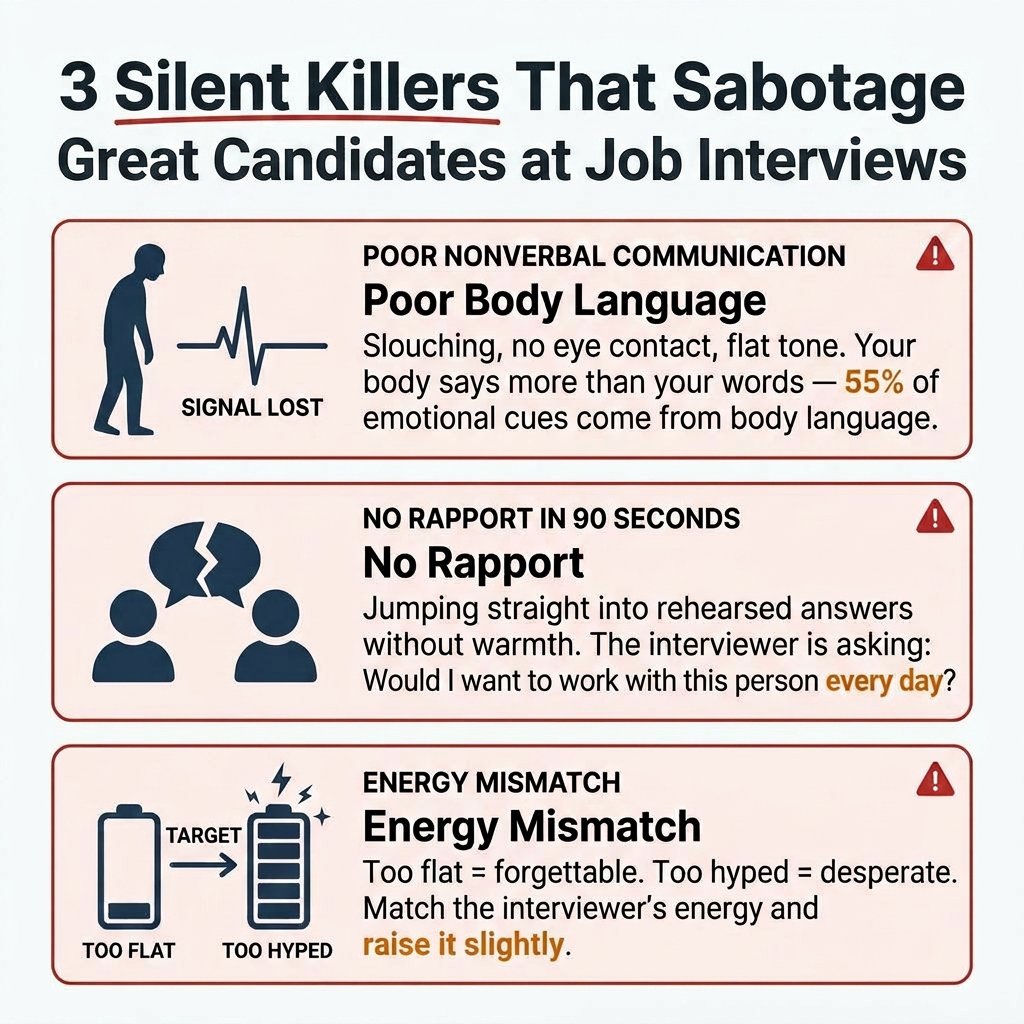
You might know everything about the role, but if you avoid eye contact, slouch, or speak in a flat tone, it sets off alarm bells. Research shows that when people judge the feelings behind a message, only 7% comes from the words themselves, 38% from tone of voice, and 55% from body language. If you give a brilliant answer but your body screams nervousness, the interviewer will remember the nervousness.
Picture two candidates who both give solid answers. The deciding factor is often likeability. What the interviewer is really asking is, “Would I want to work with this person every day?” If you jump straight into rehearsed answers without any warmth or small talk, you’ll lose them. A simple connection — asking how their day is going, or mentioning something you genuinely like about the company — goes a long way. People hire people they like.
Energy is contagious. If you seem tired or disinterested, the interviewer feels it. But coming in too hyped up can seem desperate. The sweet spot is to match and slightly raise their energy. Watch their tone at the start and adjust. A lot of strong candidates fail because they come in tired from a long day or buzzing with nervous energy.
“We get most of our clues about emotions from nonverbal cues. If your words and body language don’t match, people will believe your body every time.”
In practice, simple things like leaning in slightly, uncrossing your arms, and nodding tell the interviewer “I’m engaged and confident.” Try not to fidget — even small tapping or shaking can signal anxiety. Use your hands naturally to illustrate points. Most importantly, make sure your face matches what you’re saying: when you’re talking about something positive, smile.
Alex was a software engineer with an excellent resume. But in every interview, he answered politely, barely made eye contact, and never smiled. Interviewers said “technical skills are great, but hard to get a read on him.”
Jia was a data scientist with the same skill level. Jia started with a warm hello, gave a confident intro (“I’m really excited to be here”), and sat up straight the whole time. Even though Jia stumbled on one technical question, the interviewer said “she seems like someone I’d want on my team.”
The difference? It was entirely about how they came across — not what they knew.
The Pre-Interview Power Ritual Framework
Here’s a different approach: treat preparing your how to say it like a ritual. Athletes and performers use pre-game routines to get into “the zone,” and you can do the same. Here’s a step-by-step routine for the 10 minutes before you walk in:
Find a quiet spot (even a bathroom) 5–10 minutes before. Do a power pose: stand tall with your feet planted, chest open, hands on hips or arms raised for a moment. Research by Amy Cuddy showed that just 2 minutes of standing in a confident posture can boost your confidence and lower stress hormones by about 25%. Also take a quick walk or stretch to wake up your body.
Pause and take slow, deep breaths. Breathe in for 4 counts, hold for 4, breathe out for 4. This calms your nerves. While breathing, picture the interview going well — imagine walking in confidently and the interviewer nodding along. This kind of mental rehearsal is used by athletes and can reduce anxiety by helping your brain prepare for success.
Repeat a short phrase to yourself, like “I’m prepared, calm, and engaging” or “This is just a conversation about what I’m good at.” The goal is to shift your inner voice from negative (“I hope I don’t mess up”) to positive. Quickly remind yourself of your top achievements — you did lead that project, you have done this before.
Warm up your voice. Hum quietly or do some “ooo-ahhh” sounds to loosen your vocal cords. Say a tongue twister to sharpen your pronunciation (“red leather, yellow leather”). This prevents the flat, monotone delivery that comes from tension. Then say your opening line out loud once — you want it to sound natural and energetic, not rehearsed.
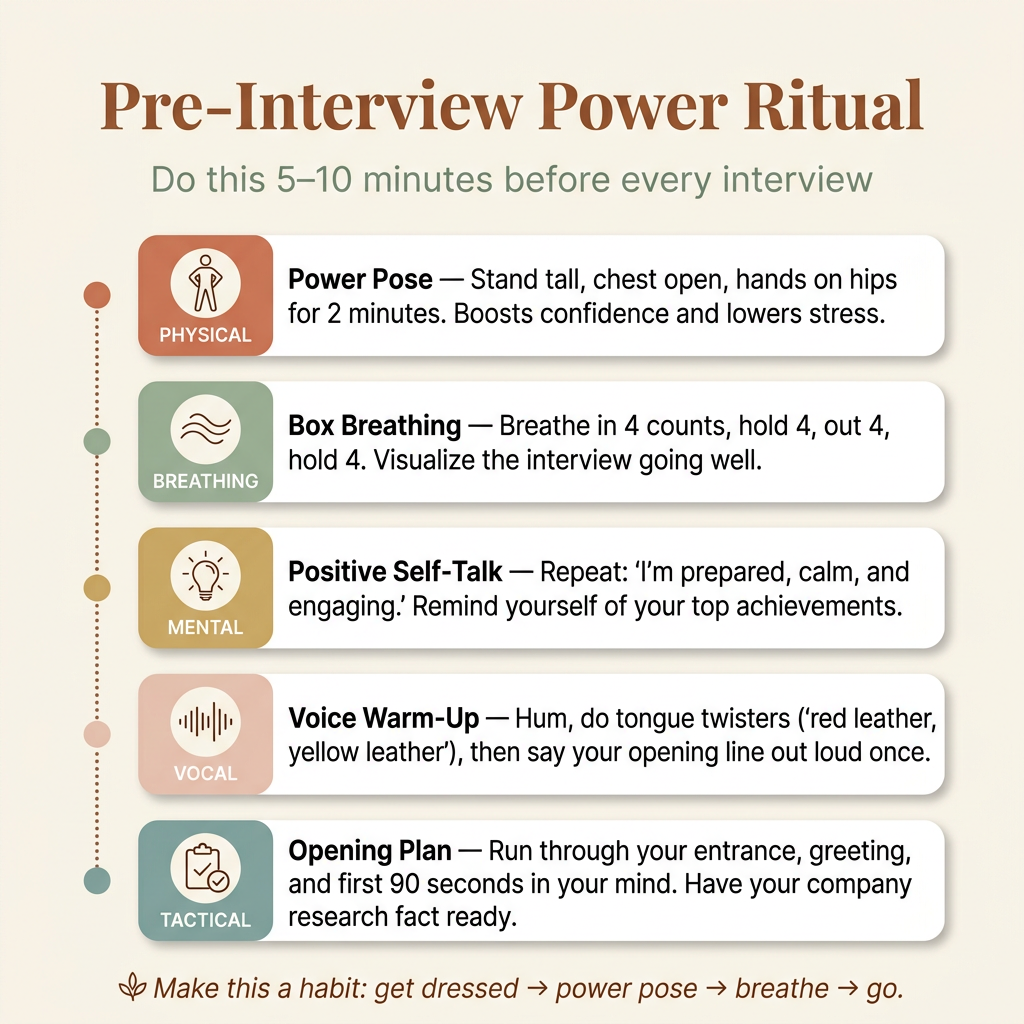
Making this routine a habit — get dressed, power pose, breathe, go — turns nervous energy into confident readiness. You’re training your body and mind to act the way you want to feel.
Counterintuitive Conclusion: Practice Delivery, Not Just Content
You might be thinking — all this focus on feelings and impressions? Isn’t that just playing a game? Not at all. It’s using what the research tells us to give yourself the best chance. The advice “just be yourself” misses half the picture. You are yourself, but there’s also the version of yourself you present. You can’t control other people — only yourself. So take control of the impression you make.
The research is clear: interviewers often choose not the person with the best answers, but the person who made them feel confident about hiring them. The person who gets the offer isn’t always the smartest — it’s the one who felt most engaging and likeable in those first few minutes.
Now you have a strategy: spend half your prep time on practising your delivery. That means doing mock interviews where you focus on eye contact and tone, not just rehearsing stories. It means practising your entrance and Zoom setup as much as studying technical problems. This is exactly where practising with an AI mock interviewer makes a real difference. You can record yourself answering questions, see how you come across on video, and get feedback on your confidence and body language. It’s not just for practising answers — it’s a safe space to work on your presence, test your opening lines, and refine how you come across until it feels natural.
The statistics might be surprising — but they’re also empowering. Now that you know how the game works, you can play it. You have a real advantage. Instead of feeling frustrated by an unfair process, use what you’ve learned. Prepare differently: practise being a great interviewee, not just reciting answers. Focus on what you can control — your body language, your energy, and your confidence.
“Over-preparing answers while neglecting your delivery is the biggest interview mistake. The candidate who feels right to the interviewer often wins.”
Key Takeaways
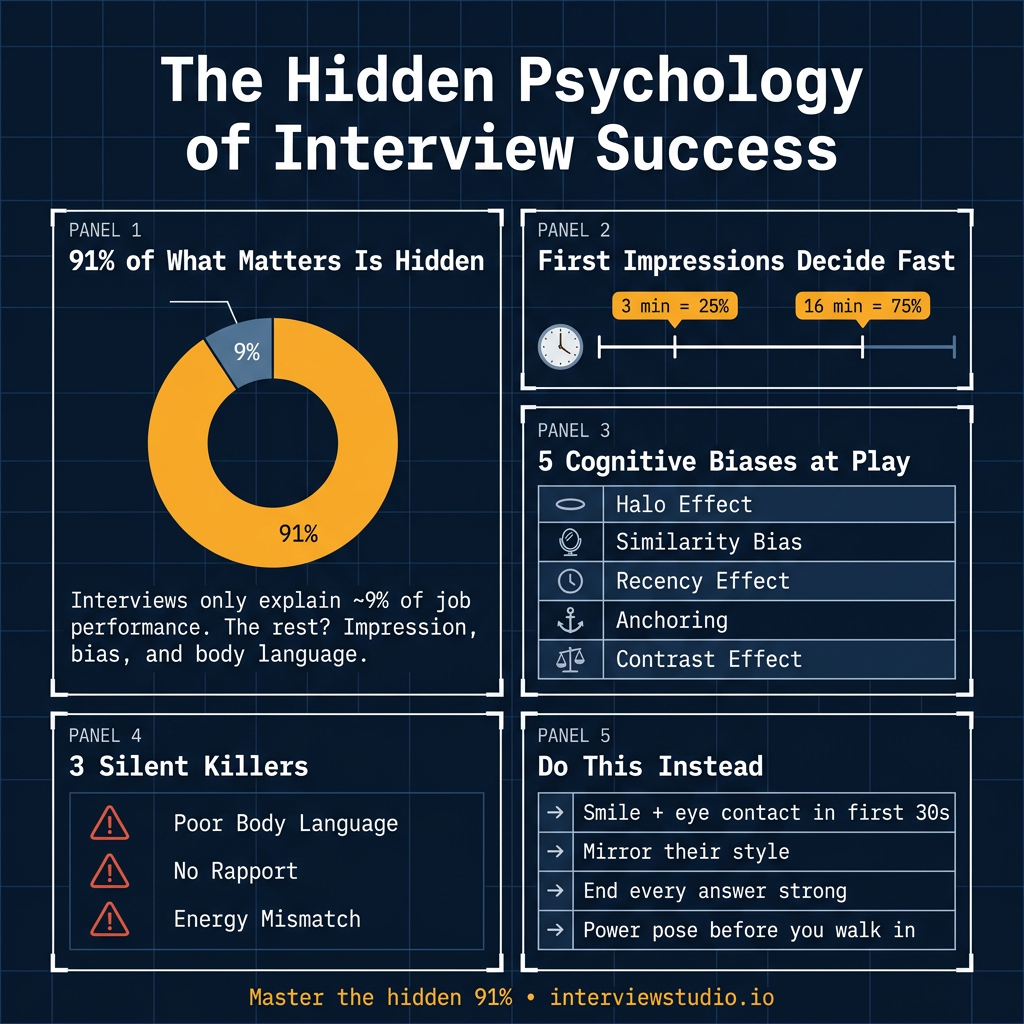
- Interviews rarely predict job performance. Only about 9% of job performance can be predicted from interview answers. The other 91% comes down to impressions and fit.
- First impressions matter more than most answers. Recruiters form opinions in seconds — often within 3 minutes — then look for evidence to confirm them. Nail your entrance and greeting.
- Leverage cognitive biases, don’t ignore them. Use the Halo effect by starting strong, Recency by finishing strong, Anchoring by leading with your biggest achievement, and Similarity by matching the interviewer’s style.
- Nonverbal cues are crucial. Your posture, eye contact, and tone of voice often say more than your words. No amount of perfect answers can make up for a slumped posture or a flat tone.
- Calibrate your energy. Match the interviewer’s energy and bring it up just a little. Too flat and you’re forgettable. Too intense and you seem desperate.
- Prepare differently. Spend as much time practising your delivery and presence as you do rehearsing answers. Visualise success, do power poses, and treat the opening seconds like a pitch.
Once you understand these psychological factors, you turn interview traps into tools. The real secret? Make the interviewer feel confident they want to hire you, and your chances go up dramatically. Once you see the interview as a human interaction rather than a quiz, you’ve got the advantage.
Ready to Master the Hidden 91%?
Try our AI mock interview platform for free. It’s not just for practising answers — it’s designed to help you improve your body language, tone, and connection in a realistic setting. Practise your entrance, build your confidence, and get feedback on how you present yourself.
Start Your Free Mock Interview →