
Here’s the number that should change how you prepare: according to hiring platform interviewing.io’s analysis of over 100,000 real technical interviews, dropping a single point in your coding score can make your rejection rate skyrocket sixfold — but the same isn’t true for communication inside that same round. Most engineers read that stat and conclude “just grind more LeetCode.” That’s the wrong takeaway, and it’s the exact mistake that quietly costs strong engineers their offers.
The truth is messier and more useful: software engineer interview prep isn’t one skill, it’s three — coding, system design, and behavioral — and each one is scored differently, weighted differently by seniority, and won or lost in different ways. Grinding 500 random LeetCode problems while skipping system design and rehearsing your behavioral stories for twenty minutes the night before isn’t thorough preparation. It’s preparation for one-third of the interview.
This is the complete guide to all three. We’ll cover the 3-pillar framework that defines every modern technical interview, the optimal coding interview preparation strategy (and why the Blind 75 beats grinding hundreds of problems), a system design interview framework you can apply to almost any question, the behavioral gap that sinks strong engineers, how prep should differ by company type, and a realistic 8–12 week study plan you can start this week.
The 3-Pillar Framework Behind Every Software Engineer Interview
Every technical interview loop, whether at a five-person startup or a five-hundred-thousand-person tech giant, is built from the same three pillars — they’re just weighted differently depending on the role and level.
- Data Structures & Algorithms (roughly 50% of technical rounds). The coding interview — solving problems on a whiteboard or shared editor, usually across 2–3 dedicated rounds.
- System Design (roughly 30%). Designing large-scale systems, becoming a required and heavily weighted round starting around the mid-level.
- Behavioral & Culture Fit (roughly 20%). Assessing communication, ownership, collaboration, and how you handle ambiguity and conflict.
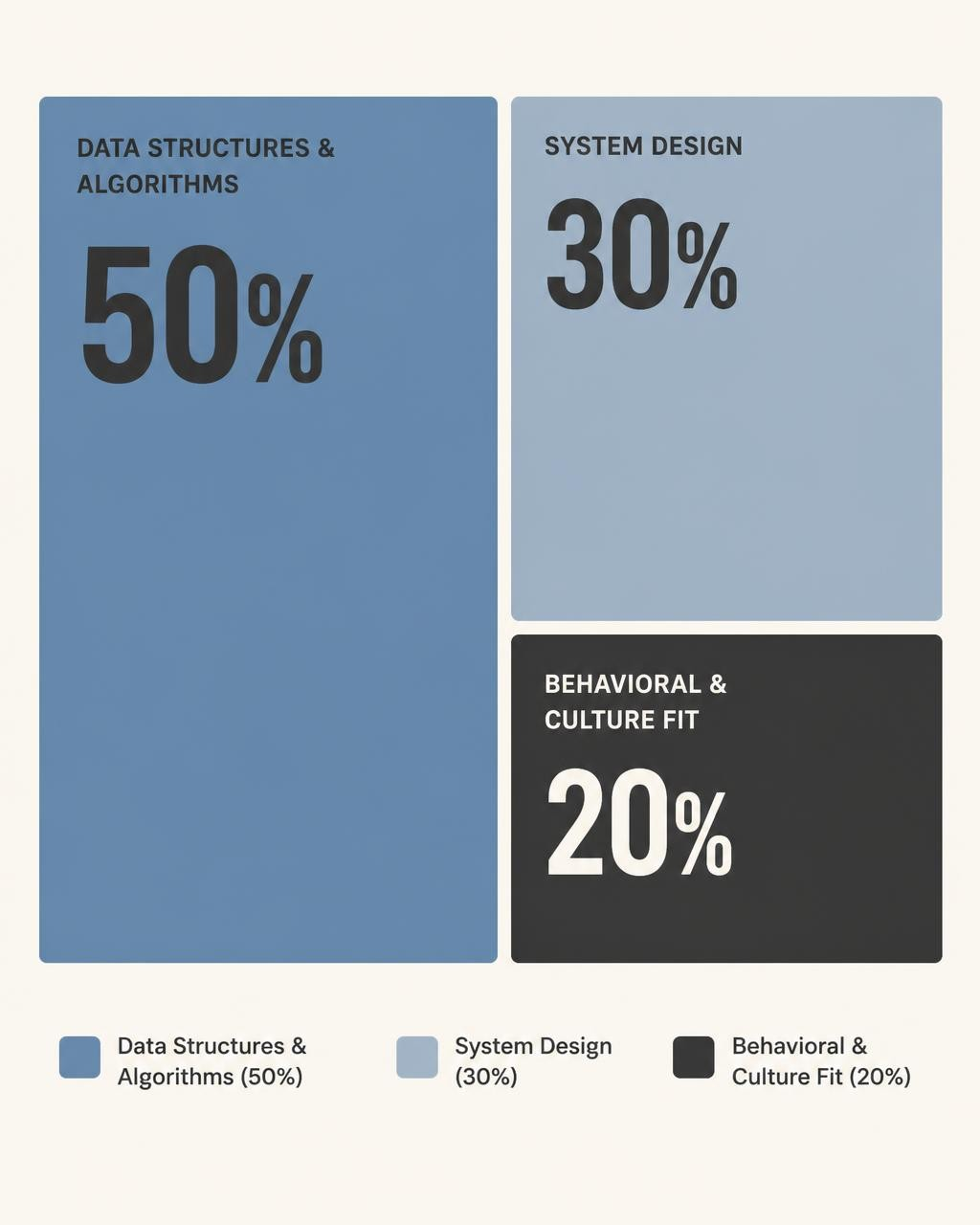
The weighting shifts as you get more senior. Junior and new-grad loops lean harder on coding rounds, because there’s less career history to evaluate. By the time you’re interviewing for senior or staff roles, system design and behavioral signal carry noticeably more weight — a brilliant coder who can’t design a scalable system or work well with a team becomes a real liability at that level, not just a nice-to-have gap.
Why This Framework Matters More Than It Looks
Modern engineering hiring loops have also simply gotten longer. Recruiting data from Gem’s 2025 Recruiting Benchmarks report found that hiring teams now conduct roughly 42% more interviews per hire than they did in 2021 — 20 interviews on average, up from 14. More interviews means more opportunities to be evaluated on all three pillars, not just the one you’re most comfortable with.
If you’ve only prepared for the coding round, you’ve prepared for about half the interview — and the half that gets easier to fake-your-way-past gets harder every year.
This is also good news, in a way: the process is noisier than it feels from the inside. interviewing.io’s data found that even genuinely strong candidates fail technical interviews as often as 22% of the time, and that only about a quarter of interviewees perform consistently from one interview to the next. A single rejection tells you almost nothing about your actual ability — it’s one noisy data point, not a verdict.
Pillar One: Data Structures & Algorithms — Why Pattern-Based Practice Beats Grinding 500 Problems
Ask any engineer who’s been through the process which part of interview prep felt the most soul-crushing, and most will say the same thing: staring at a list of 400+ LeetCode problems with no idea where to start. The good news is that you don’t need to solve all of them.
The Blind 75 Origin Story
In 2018, Yangshun Tay — then a Staff Engineer at Meta and the author of the Tech Interview Handbook — posted a curated list of 75 problems on the anonymous professional network Blind. His reasoning, in his own words: “LeetCode has over a thousand questions. Which should you practice? Hence years ago, I curated a list of the most important 75 questions… Many other LeetCode questions are a mash of the techniques from these individual questions.”
That list became known as the Blind 75, and it’s still one of the most recommended coding interview preparation resources in existence. Tay later refined it into Grind 75, reorganized by difficulty with built-in time estimates, and the community-built NeetCode 150 extended the list further with video walkthroughs for every problem.
The Patterns That Cover (Almost) Everything
The reason a list of 75–150 problems can meaningfully prepare you for a thousand-question universe comes down to one idea: most coding interview questions aren’t unique — they’re variations on roughly 15 recurring patterns. Once you recognize the pattern, the specific problem becomes far more solvable.
The core patterns worth mastering, in roughly the order most engineers find it useful to learn them:
- Two pointers — for sorted arrays, palindrome checks, and pair-sum problems
- Sliding window — for substring and subarray problems with a moving range
- Fast & slow pointers — for cycle detection and linked list problems
- Breadth-first search (BFS) / Depth-first search (DFS) — for trees, graphs, and grid traversal
- Binary search — for sorted data and “search space” problems
- Backtracking — for combinations, permutations, and constraint-satisfaction problems
- Dynamic programming — for optimization problems with overlapping subproblems
- Monotonic stack — for “next greater/smaller element” style problems
- Topological sort — for dependency and ordering problems
- Union-Find (Disjoint Set) — for connectivity and grouping problems
This is the single biggest mindset shift in coding interview preparation: stop asking “have I solved this exact problem before?” and start asking “which pattern is this?” As one engineer put it plainly in a widely shared community post: “If you actually learn the 10 core patterns, you don’t need to do 400 problems. You’re just re-solving the same 10 algorithms with different problem statements.”
The data backs this up. interviewing.io’s own internal analysis found “seriously diminishing returns associated with doing more than 500 questions” — and self-reported numbers from candidates who’ve received offers vary wildly, from 150 problems to over 1,000, with no clear correlation between raw volume and outcome once you’re solving with real understanding rather than memorized solutions.
One habit matters more than volume: practicing out loud, with follow-ups. A recurring complaint in engineering communities is that solo grinding never trains you for the moment an interviewer changes your constraints mid-problem — something that happens in the large majority of real interview rounds. Grinding alone in silence doesn’t build that muscle. Talking through your reasoning out loud, and practicing how you adapt when the interviewer adds a twist, does. The same pause-and-structure techniques used for unexpected interview questions work particularly well here.
Pillar Two: System Design — The Framework That Works Every Time
If coding interviews test whether you can solve a well-defined problem, system design interviews test something almost opposite: whether you can bring structure to an intentionally vague, open-ended one. This is the round that separates strong mid-level engineers from senior and staff-level candidates, and it’s the round most engineers under-prepare for.
The Five-Step System Design Framework
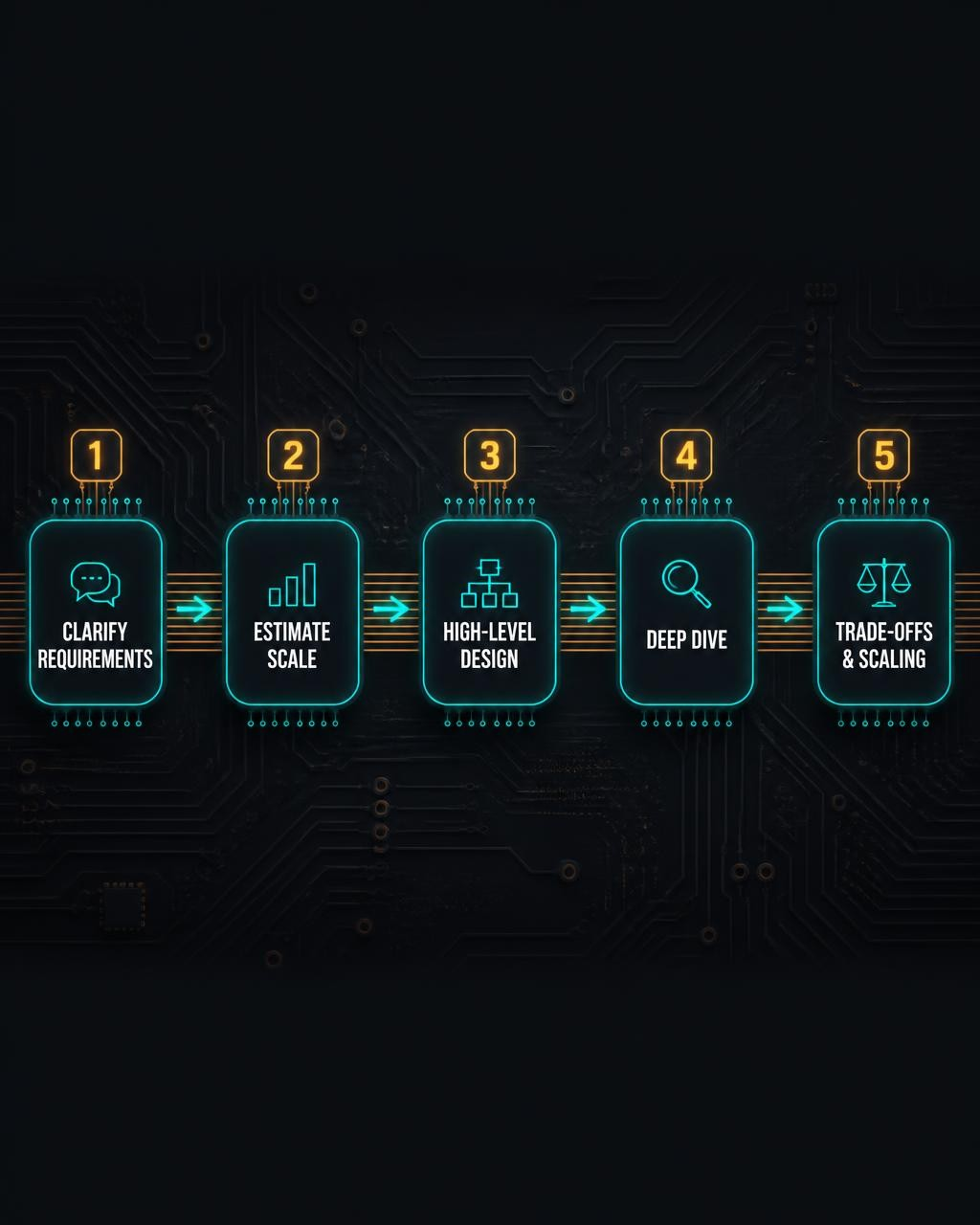
Nearly every well-regarded system design resource — Alex Xu’s System Design Interview, ByteByteGo, Grokking the System Design Interview, and the Tech Interview Handbook — converges on the same underlying shape. Memorize this structure and you can walk into almost any system design question with a plan:
- Clarify requirements. Before you design anything, ask questions. Separate functional requirements (what the system needs to do) from non-functional requirements (latency, availability, consistency, scale). This step alone signals seniority — junior candidates jump straight to drawing boxes; senior candidates ask what “success” actually means first.
- Estimate scale. Do rough back-of-envelope math: queries per second, storage growth over time, bandwidth needs. These numbers aren’t decoration — they directly drive later decisions about caching, sharding, and load balancing.
- Sketch the high-level design. Draw the major components — clients, API layer, services, databases, caches, CDN, message queues — and how data flows between them. Treat this as a collaborative whiteboard session with your interviewer, not a solo presentation.
- Deep-dive on 1–2 components. Pick the most interesting or highest-risk part of the system and go deep. This is where senior and staff candidates are expected to lead the conversation without much prompting; junior candidates are often guided here by the interviewer.
- Discuss scaling, trade-offs, and failure modes. Every design has weaknesses. Naming them yourself — single points of failure, consistency trade-offs, what happens at 10x or 100x scale — is far stronger than waiting for the interviewer to find them.
Worked Example: Design a URL Shortener
This is one of the most commonly asked system design questions, precisely because it’s small enough to fully solve in 45 minutes while still requiring every step of the framework.
- Requirements: shorten a long URL, redirect a short URL to the original, low latency on redirects, high availability.
- Estimate: if the service handles 100 million new URLs a day, that’s roughly 1,160 writes per second. With a 100:1 read-to-write ratio (redirects vastly outnumber new links), that’s around 116,000 reads per second.
- Design: use Base62 encoding to generate short codes — a 7-character code alone supports over 3.5 trillion unique URLs. Store mappings in a key-value or NoSQL database for fast lookups, and add a caching layer such as Redis in front of it for hot, frequently accessed links.
- Deep dive & trade-offs: discuss 301 (permanent) vs. 302 (temporary) redirects, how to support custom aliases, and how to avoid a single point of failure in whatever service generates unique codes.
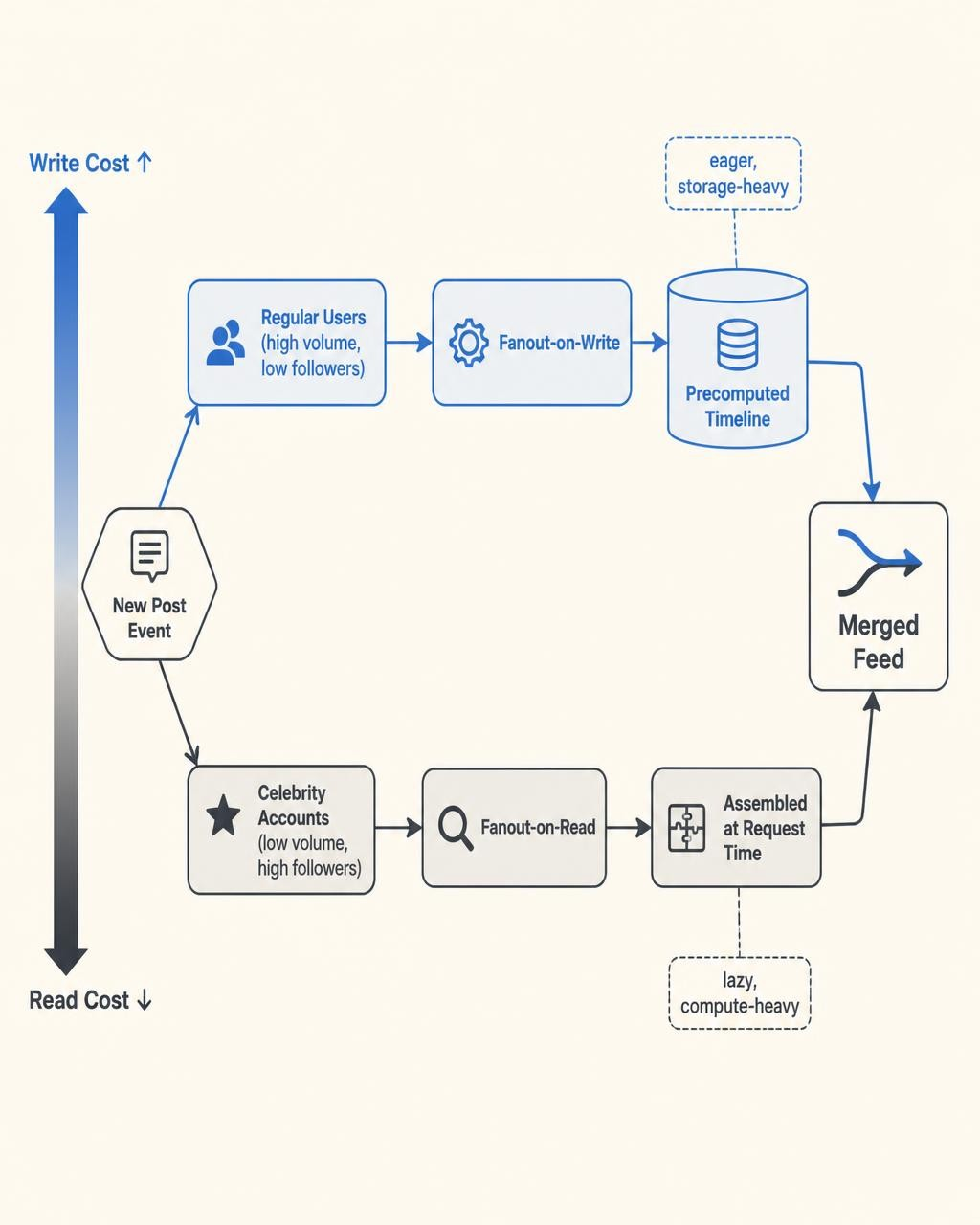
Worked Example: Design Twitter’s News Feed
This question is popular precisely because the “obvious” solution doesn’t scale, and watching how a candidate discovers that in real time is genuinely revealing.
The central tension is called fanout. Fanout-on-write pushes every new post directly into each follower’s precomputed timeline the moment it’s posted — reads are instant, but a single post from an account with millions of followers triggers millions of writes at once. Fanout-on-read does the opposite: it assembles each user’s feed only when they open the app — writes stay cheap, but reads get expensive and slow at scale.
The strong answer is a hybrid, and proposing it unprompted is a strong senior-level signal: use fanout-on-write for regular accounts (say, under 10,000 followers), fall back to fanout-on-read for high-follower accounts, and merge the two at read time. As one system design guide frames the ideal closing summary: “We chose hybrid fan-out because neither pure approach scales alone here. Push collapses on write for celebrities, pull collapses on read for high-follow users.” Senior candidates often go a step further and describe a lightweight ranking pipeline layered on top — retrieving candidates, scoring them, and re-ranking before the feed is served.
The best way to internalize this isn’t to memorize diagrams. Run the framework as a conversation in a mock interview with follow-up feedback, where your assumptions and trade-offs can be challenged in real time.
Pillar Three: The Behavioral Gap That’s Quietly Costing Engineers Offers
Here’s an uncomfortable pattern hiring managers see repeatedly: an engineer solves the coding problem cleanly, nails a solid system design, and then loses the offer anyway — because the behavioral round revealed someone who’d be genuinely difficult to work with, or who simply couldn’t explain their own thinking clearly.
This is the gap most engineers don’t see coming, because it’s invisible until it costs you something. As one engineering hiring guide bluntly puts it: “Spending 200 hours on LeetCode and 20 minutes on behavioral prep is the most common mistake, and it sinks strong coders.” The Tech Interview Handbook, co-authored with a former Meta Senior Engineering Manager and Hiring Committee Chair, is just as direct: “Companies don’t want to hire brilliant jerks… Hiring a talented engineer that cannot work with others can ultimately be a net deficit.”
At companies like Meta, behavioral rounds aren’t a casual formality — they’re scored against specific signal areas: scope, ownership, communication, growth, dealing with ambiguity, perseverance, conflict resolution, and leadership. One illustrative account from a hiring guide describes a mid-level engineer with “a solid algorithm plan but he went silent while coding” during the technical round — he passed, but interviewers explicitly noted that stronger communication could have won him a better offer, not just a passing grade.
STAR, Adapted for Engineers
Most job seekers have heard of the STAR method (Situation, Task, Action, Result) for behavioral questions. Engineers tend to use it wrong in one specific way: they over-explain the technical situation and under-explain their own individual contribution.
Here’s how to weight it correctly for a technical context:
- Situation — keep it brief. One or two sentences of context. Don’t re-litigate the entire system architecture.
- Task — state your specific responsibility. What were you actually accountable for, not the team as a whole?
- Action — this is where the real weight goes. Describe what you did, specifically, using “I” rather than “we.” Interviewers already assume you had a team; they’re evaluating your individual judgment and contribution.
- Result — quantify it wherever possible. Latency improved by how much? Incidents reduced by how much? A number is always more convincing than an adjective.
Build a story bank before your interviews start, not the night before one. Prepare 5–12 real stories from your career, and tag each one to the signal areas it demonstrates (ownership, conflict resolution, dealing with ambiguity, and so on) so you can quickly match the right story to whatever behavioral question comes up.
The engineer who explains their thinking clearly will often beat the engineer with the cleaner code — because communication is the skill that scales past a single interview and into every day of the actual job.
Use the full STAR Method Masterclass to turn your raw project examples into concise, evidence-backed stories before you begin rehearsing them.
How Prep Should Differ by Company Type
Not every technical interview prep plan should look the same, because not every company is testing for the same thing.
- FAANG / Big Tech. A highly structured, standardized, multi-round pipeline built to minimize false positives across thousands of candidates. Expect heavy algorithmic depth, a dedicated system design round from mid-level up, and behavioral questions often anchored to a specific company framework (Amazon’s Leadership Principles being the clearest example). Prep here rewards depth and consistency across all three pillars.
- Startups. A faster, more flexible process — sometimes compressed into a single day, often involving the founder or CTO directly. Expect more practical, domain-relevant problems: take-home projects, “build this feature,” or debugging real (sometimes messy) code, along with a stronger emphasis on product sense and versatility over abstract algorithm puzzles. Don’t mistake a shorter process for an easier one — fewer rounds means each impression carries more weight.
- Mid-size companies. Usually a blend of the two — structured enough to be predictable, but with more room for practical coding and a genuine culture-fit conversation. One to two months of focused prep is typically enough.
The practical takeaway: research the specific company’s known interview format via sites such as Glassdoor or Levels.fyi before you finalize your study plan, and weight your remaining prep time toward whichever pillar that company is known to emphasize.
The 8–12 Week Preparation Timeline
Most engineers need somewhere between 8 and 12 weeks of structured preparation — add 2–4 weeks to that if you’re studying while working full-time. Here’s a stage-by-stage breakdown you can adapt to your own schedule.
Weeks 1–2 — Foundations
- Pick one programming language you’re genuinely fluent in and commit to it for the whole process.
- Learn the core coding patterns one at a time, working through 5–8 problems per pattern rather than jumping randomly between topics.
- Start your Blind 75 or NeetCode 150 list organized by pattern, not difficulty.
- Draft your self-introduction and a short list of questions to ask your interviewers.
Weeks 3–6 — Depth and Breadth
- Work through medium-difficulty problems from your list, timing yourself at roughly 20–25 minutes per problem.
- If you’re targeting mid-level or above, begin system design prep — study the five-step framework and work through 3–5 classic problems (URL shortener, a chat app, a news feed).
- Build your behavioral story bank: 5–12 STAR stories, tagged to the signal areas they demonstrate.
Weeks 7–10 — Simulation
- Do at least 5 mock interviews. This is, by a wide margin, the highest-leverage activity in this entire timeline — data from interviewing.io found that after 5 mock interviews, “regardless of where you started or where you work, your chances of passing real interviews will (on average) double.”
- Alternate coding-focused and system-design-focused practice days to avoid burning out on either one.
- Rehearse your behavioral answers out loud until each one comfortably fits under two minutes.
Weeks 11–12 — Company-Specific Tailoring
- Shift your remaining hours toward that company’s known emphasis (heavier algorithm and system design depth for FAANG; product sense and take-home polish for startups).
- Confirm the company’s current AI-use policy with your recruiter in writing before your interview — according to Karat’s 2026 engineering interview research, roughly 62% of organizations still prohibit AI tools during technical interviews, while others are actively building rounds that score how well you collaborate with AI. Don’t assume either way.

Consistent simulation builds the stamina that passive preparation cannot. An AI mock interview with actionable feedback lets you rehearse all three pillars without waiting for a real interview to expose the gaps.
Key Takeaways
The best software engineer interview prep treats coding, system design, and behavioral as three separate, trainable skills — not one long LeetCode grind with two afterthoughts bolted on. To recap:
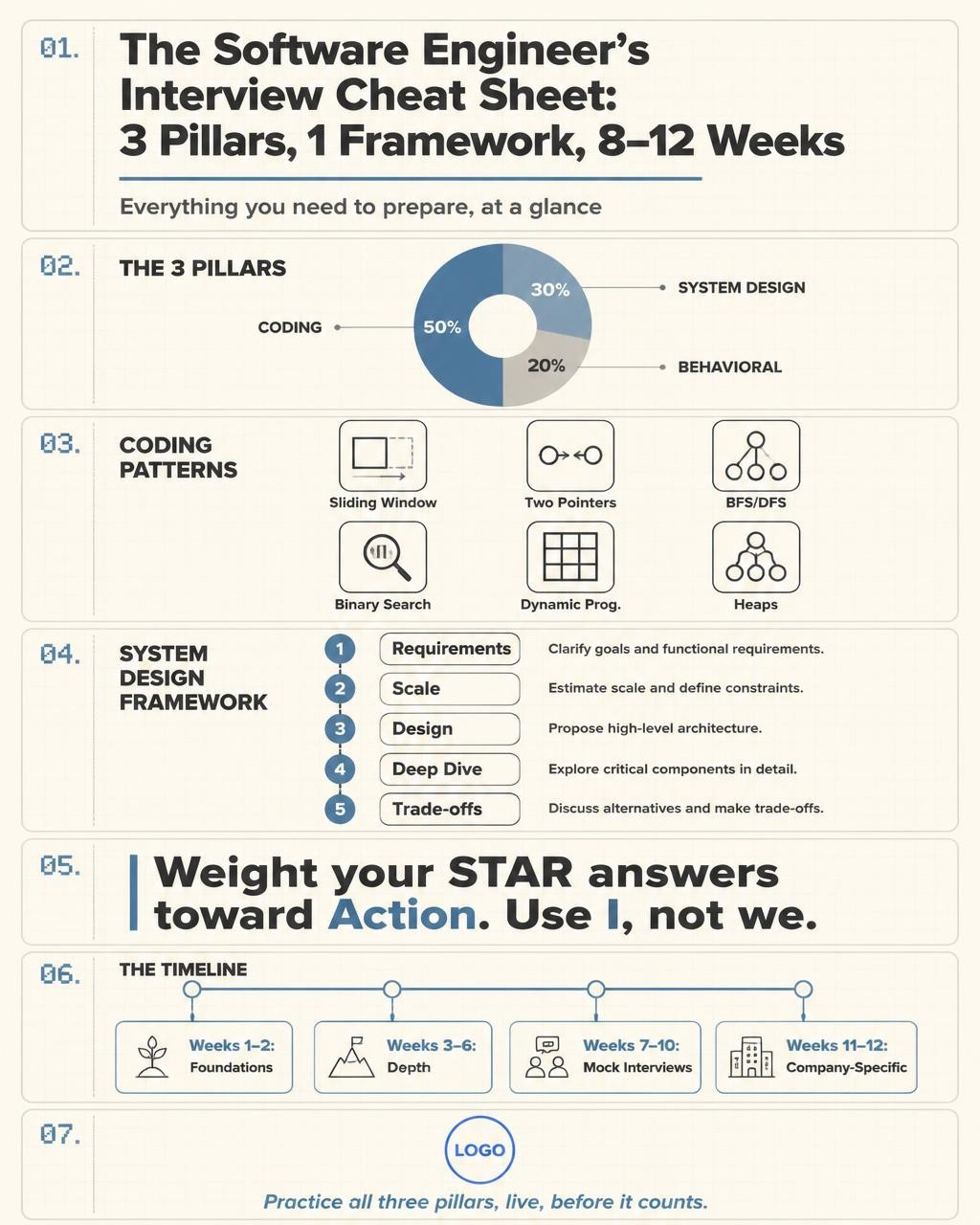
- The interview has three pillars — coding (~50%), system design (~30%), and behavioral (~20%) — and neglecting any one of them caps your outcome regardless of how strong the others are.
- Pattern-based practice beats volume. The Blind 75 and NeetCode 150 exist because roughly 15 core patterns cover the overwhelming majority of coding interview questions — mastering patterns matters more than grinding hundreds of problems.
- System design has a repeatable five-step framework: clarify requirements, estimate scale, sketch the high-level design, deep-dive on key components, and discuss trade-offs and failure modes.
- The behavioral round is where strong technical candidates quietly lose offers — weight your STAR answers toward your specific “I” actions and quantified results, not team narratives.
- Prep timelines and priorities should shift by company type — FAANG rewards depth and consistency; startups reward practical versatility and product sense.
Reading a framework and actually performing under real interview pressure are two different skills — and the data is clear that mock interviews, not more solo grinding, are what close that gap fastest. The next step isn’t another LeetCode problem. It’s saying your system design answer and your behavioral stories out loud, under conditions that actually feel like the real thing.
Practice All Three Pillars Live
Reading about the three pillars is one thing — performing across all of them, live, under real pressure, is another. Practice coding walkthroughs, system design deep-dives, and behavioral stories with an AI interviewer that asks genuine follow-up questions, the same way a real interviewer would.
Start Your Free Mock Interview