

Here’s what almost every hiring manager will tell you privately: the worst answer to “why should we hire you” isn’t a bad answer — it’s the word “passionate.” A Harvard and Wharton study found that when men and women scored identically on the same test, men rated their own performance a 61 out of 100 while women rated theirs a 46 — not because the work was different, but because of how uncomfortable it feels to state your own value out loud. If that discomfort sounds familiar, you’re not bad at interviews. You’ve just been taught the wrong goal.
Most candidates treat this question as a bragging contest. Hiring managers don’t experience it that way at all. They’re not grading how impressive you sound — they’re checking whether you understand the actual problem the role exists to solve, and whether you have proof you can solve it.
This guide flips the question around. We’ll show you what interviewers are really listening for, why “because I’m passionate” is the answer most likely to lose you the job, a simple three-part framework for building the best answer to “why should we hire you,” and word-for-word scripts for the trickiest versions of this question — including when you’re overqualified, underqualified, switching careers, or up against an internal candidate.
What Hiring Managers Are Actually Listening For (It’s Not What You Think)
Picture the two sides of this question at the same moment. The candidate is thinking: I need to prove I’m better than everyone else in this pile. The hiring manager is thinking: Does this person understand what I actually need, and can they show me evidence?
That gap is the entire problem. Career site Indeed frames the interviewer’s real intent plainly: they’re assessing “the specific value you will bring to the role and how you will solve their problems.” Not your general greatness. Your fit against a specific, current, expensive problem they need solved.
The Job Posting Is a Problem Statement, Not a Wish List
One recruiter-turned-career-coach puts it this way: “That job description they posted? That’s their problem statement.” Every bullet point under “requirements” represents something currently broken, understaffed, or underperforming inside that company.
This reframe matters because it changes what you’re building. You’re not constructing a highlight reel of your career. You’re building a case that you’ve solved this exact kind of problem before.

Why Staffing Experts Say Vague Answers Are a Red Flag
According to staffing firm High Profile, interviewers listen for clarity, ownership, and specificity — because vague answers make it difficult to understand how someone would operate in a new environment. A candidate who speaks in generalities isn’t just failing to impress. They’re actively raising doubt about whether they understand the role at all.
And here’s the encouraging part for anyone who’s ever panicked mid-answer: the “hiring managers decide in the first 90 seconds” claim is largely a myth. A peer-reviewed study of 166 interviewers evaluating 691 real applicants found only 30.4% had made their decision within the first five minutes — meaning roughly 70% of decisions were still forming well after the small talk ended. You have more room to build your case than you think.
The job posting isn’t a wish list of traits to compliment yourself with. It’s a list of problems someone is currently losing sleep over.
Why “Because I’m Passionate” Is the Worst Possible Answer
If you remember one thing from this article, make it this: passion is not evidence. It’s a feeling you’re claiming to have, and feelings can’t be verified in a 30-minute conversation.
Career coaches see the same handful of answers on repeat, and they’ve become shorthand for “this candidate didn’t prepare”:
- “I’m a hard worker.”
- “I’m a fast learner.”
- “I’m passionate about this industry.”
- “I’m a team player.”
- Reciting the résumé the interviewer is already holding.
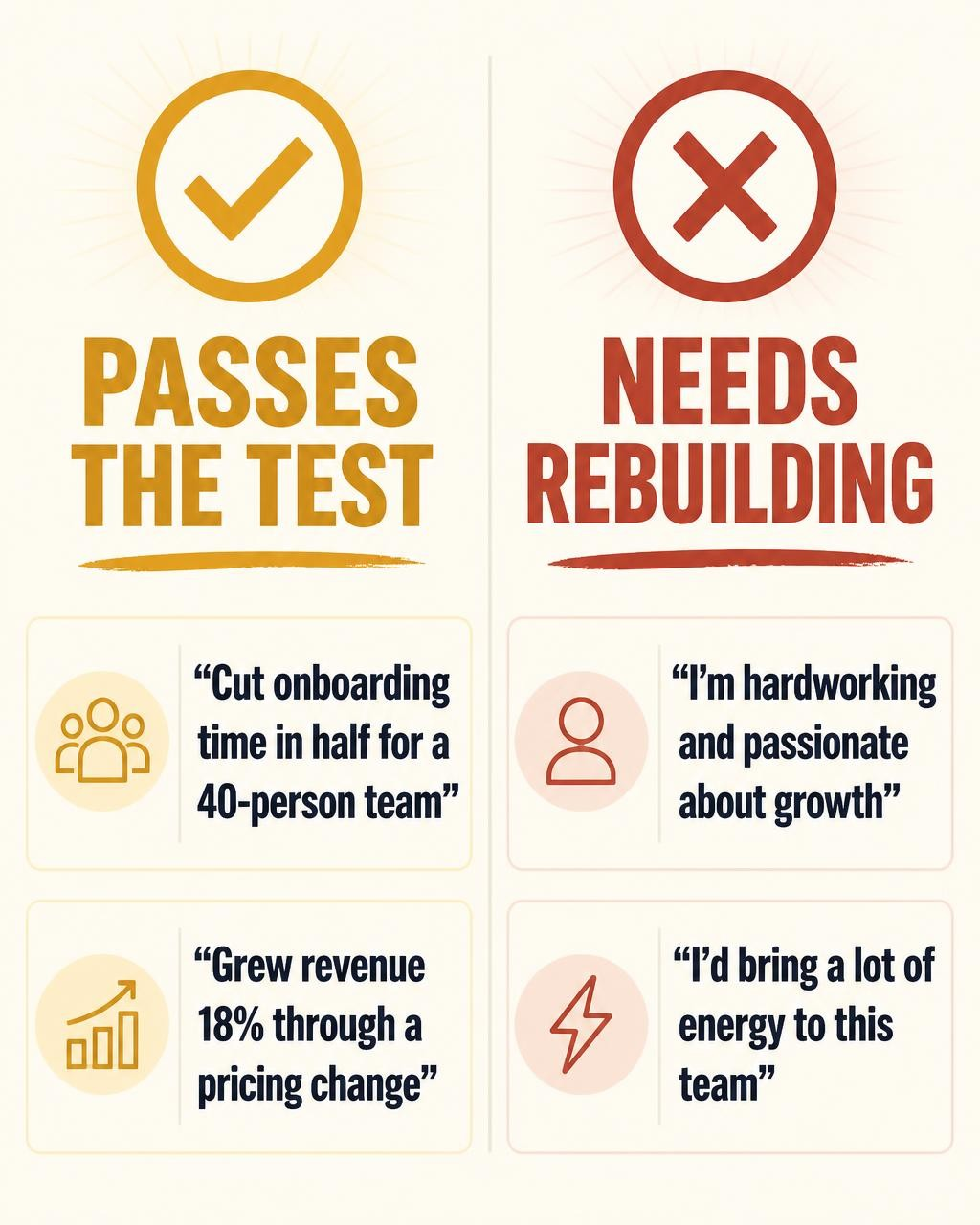
One recruiter’s blunt assessment of these lines: “Saying ‘I’m a hard worker’ or ‘I’m a fast learner’ doesn’t mean anything. Everyone says that.” That’s the real problem — not that these traits are bad, but that they’re unfalsifiable. Every single candidate in the pipeline could claim the exact same thing, which means it does nothing to differentiate you.
What to Say Instead: Trade Adjectives for Evidence
The fix isn’t to sound more passionate. It’s to replace the adjective with a number. Compare these two answers to the same question:
“I’m really passionate about customer experience and I think I’d bring a lot of energy to this team.”
“In my last role, I rebuilt our onboarding flow after noticing a 22% drop-off in the first week. Within a quarter, retention at that stage was up 15%. I noticed your job posting mentions improving early-customer retention as a priority — that’s the exact problem I spent the last two years getting good at.”
Notice what changed. The strong version doesn’t claim a feeling — it states a fact and connects it directly to their stated need. That’s a genuinely different answer, not a more polished version of the same one.
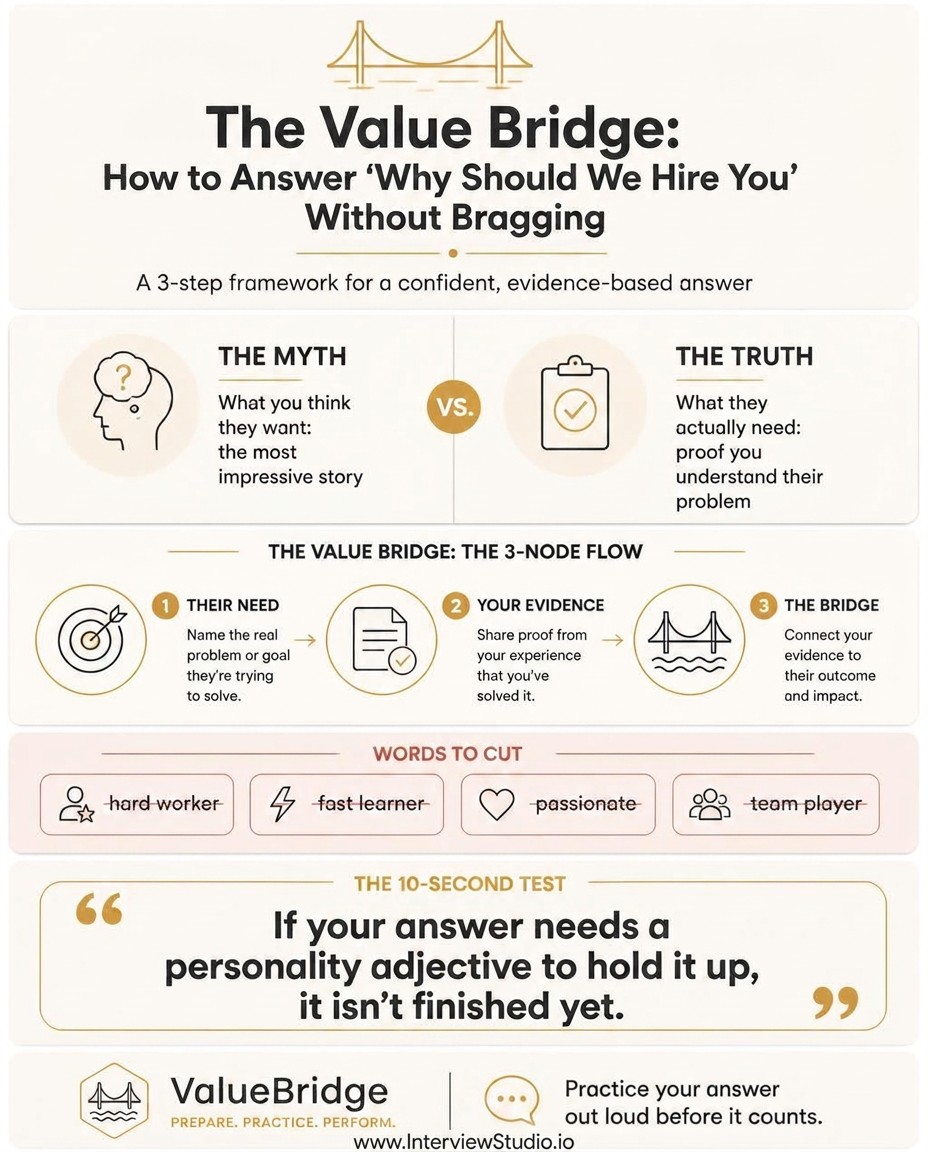
The Value Bridge Framework: How to Build an Answer That Actually Works
This is the core tool of this article, and it works whether you love talking about yourself or find the whole exercise excruciating — because it isn’t about performing confidence. It’s about presenting a match.
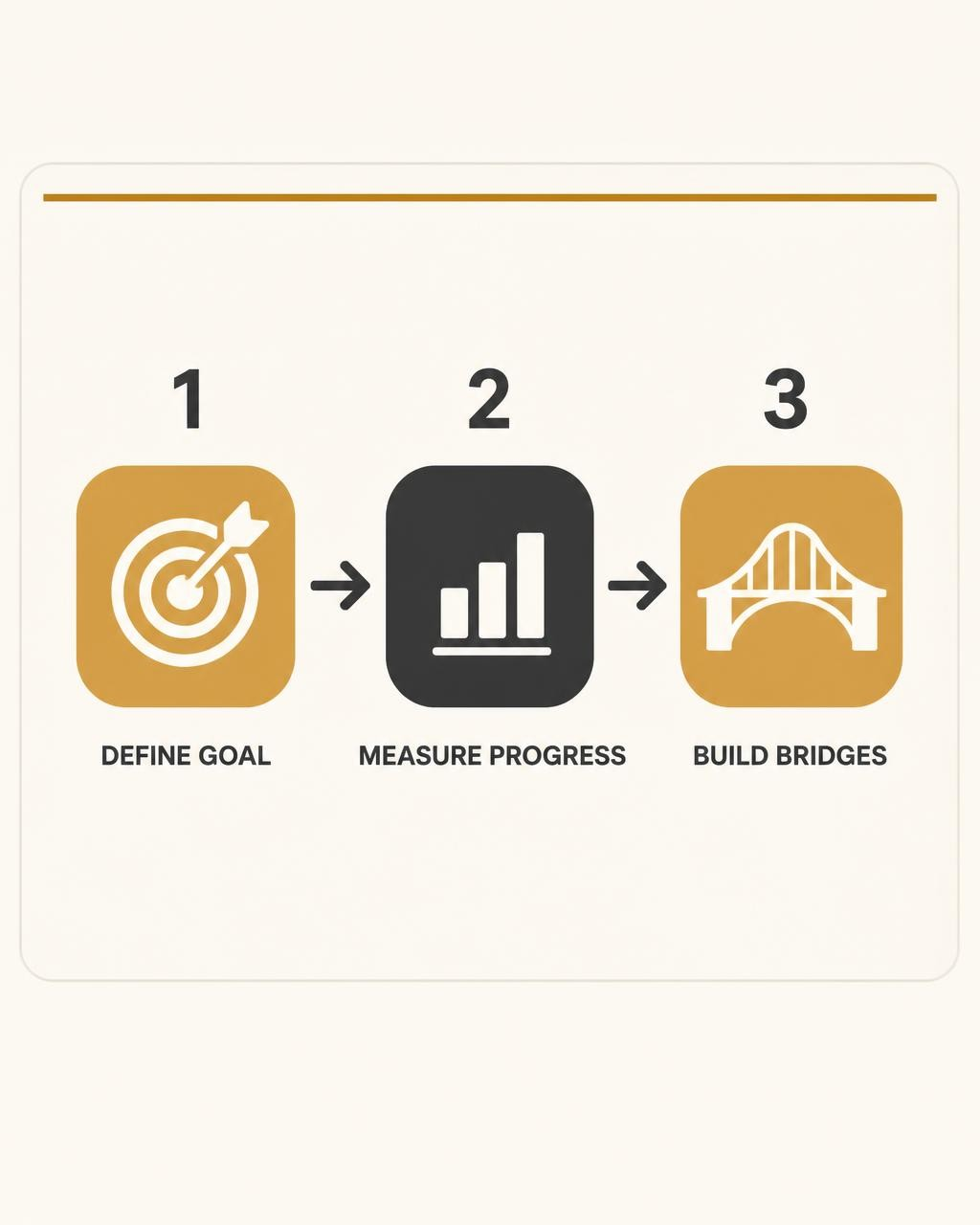
The Value Bridge has three parts:
- Their need — a specific requirement pulled directly from the job description or your research into the team’s current priorities.
- Your evidence — a real, quantified example proving you’ve delivered against that exact type of need before.
- The bridge — one explicit sentence connecting the two, so the interviewer doesn’t have to make the connection themselves.
Step 1: Identify Three Specific Needs, Not General Ones
Pull out the job description and highlight the three or four requirements that show up repeatedly or sound most urgent. Skip generic requirements like “excellent communication skills” — focus on the specific, role-defining ones: “reduce churn,” “lead a team through a system migration,” or “build the analytics function from scratch.”
Step 2: Match Each Need to a Result You Can Prove
For each need, find one moment from your career where you delivered something measurable in that exact category. This is where specificity beats seniority — a mid-level candidate with a precise, quantified story will consistently outperform a senior candidate who speaks only in generalities.
Step 3: Build the Bridge Sentence
This is the piece most candidates skip, and it’s the one that makes hiring managers’ jobs easy. Don’t make them infer the connection — say it outright: “That’s the exact challenge your team is facing with [specific need], which is why I think this is a strong fit.”
“Looking at your job posting, three things stand out: you need someone who can shorten your sales cycle, manage a small team, and clean up your CRM data. In my current role, I cut our average sales cycle from 45 days to 31 by restructuring our qualification process. I’ve also directly managed a team of four reps, two of whom were promoted under my mentorship. And I led a full CRM data-cleaning project that improved forecast accuracy by 20%. Those are the three things you listed as priorities — which is exactly why I think I’d add value quickly here.”
That answer contains zero adjectives about the candidate’s personality. It’s a factual, sourced match — and it’s far more persuasive than any amount of enthusiasm.
If your evidence still feels generic, use the company-research and story-banking process in our 7-Day Interview Preparation Blueprint.
The 10-Second Elevator Test: How to Know If Your Answer Is Ready
Here’s a simple diagnostic sales strategists have used for decades, adapted for interviews: if you can’t state your core value in one sentence, your answer isn’t finished yet.
Try saying your answer out loud, then compress it down to a single sentence that names the problem you solve. As one elevator-pitch framework puts it plainly: “If your value proposition needs a second sentence, it is not finished.”
Examples of a passing 10-second answer:
- “I’m the person who takes messy operational processes and turns them into systems that scale — I did it for a 40-person team last year and cut onboarding time in half.”
- “I specialize in taking underperforming product lines and finding the one change that moves the needle — most recently a pricing shift that grew revenue 18% in one quarter.”
If your one-sentence version comes out as “I’m hardworking and passionate about growth,” that’s the signal to go back to the Value Bridge and rebuild it with a real result. The elevator test isn’t about being clever or catchy — it’s a forcing function that stops you from hiding behind vague language.
If your answer to “why should we hire you” needs a personality adjective to hold it up, it isn’t finished yet.
Scripts for the Hardest Versions of This Question
The Value Bridge framework holds up in every scenario — but a few situations need an extra layer of handling. Here’s how to adjust it.
When You’re Overqualified
The hiring manager’s real fear isn’t your ability — it’s whether you’ll get bored and leave in six months. Address it directly instead of hoping they won’t notice.
“I know my background might look like more seniority than this role typically calls for, so I want to be upfront about why I’m here: [specific, genuine reason — wanting deeper focus, stepping back from heavy travel, returning to hands-on work]. What that means for you is I can contribute at full speed from day one, and I’ll bring mentorship to the team as a side benefit, not a distraction from the role.”
When You’re Underqualified on Paper
Lead with velocity and transferable proof, not apology. Skip phrases like “I know I don’t have much experience in...”
“I haven’t held this exact title before, but I’ve done the core of this job already — [specific project, freelance work, or cross-functional responsibility]. What I bring is speed: I taught myself [specific skill] in [timeframe] and used it to [specific result]. I’d rather show you how fast I close a skill gap than pretend I don’t have one.”
When You’re a Career Switcher
Don’t apologize for the pivot — translate it. The skill, not the job title, is what transfers.
“My background is in [previous field], but the core skill your role needs — [specific skill, e.g., ‘breaking down complex information for a non-expert audience’] — is the exact thing I did every day for [X years] as a [previous role]. The industry is different. The skill isn’t.”
When You’re Competing Against an Internal Candidate
You likely know, or suspect, someone inside already has a head start. Lean into what only an outsider can offer: fresh perspective and outside pattern-matching.
“I imagine you’re also considering people who already know this team well, and that’s real value. What I’d add is a perspective from outside this company — I’ve seen how [specific type of problem] gets solved at [type of company/industry], and I can bring that pattern-matching here without the blind spots that come from being close to the day-to-day.”
For more structured answer preparation, work through our guide to 50 behavioral interview questions.
Key Takeaways
The best answer to “why should we hire you” isn’t the most confident-sounding one — it’s the most specific one. To recap:
- Hiring managers aren’t grading your self-belief — they’re checking whether you understand their actual problem and can prove you’ve solved it before.
- “Passionate,” “hard worker,” and “team player” are unfalsifiable — every candidate can say them, so they carry zero persuasive weight.
- Use the Value Bridge: their need → your evidence → the explicit connecting sentence.
- Run the 10-second elevator test before the interview — if your answer needs a personality adjective to hold together, rebuild it around a result.
- Adjust for your scenario — overqualified, underqualified, career switcher, or internal competition all call for a direct, honest addition to the same framework, not a different one.
You don’t need to become a different, more self-promotional person to answer this question well. You need a framework that turns “why should we hire you” from a performance into a fact pattern — and the more you practice building that fact pattern out loud, under real interview pressure, the more natural it becomes.
Use the STAR Method Masterclass to turn your strongest evidence into clear, memorable stories.

Practice Your Value Bridge Out Loud
Building an evidence-based answer on paper is one thing — saying it under real pressure is another. Practice with an AI interviewer that asks genuine follow-up questions.
Start Practicing Free